Jeans Wash Samples: Approve Appearance and Fit Together
A jeans wash sample should be reviewed as both an appearance sample and a fit sample. Finishing can change tone, contrast, feel and dimensions together. Separate those observations in the comment sheet, then approve their combined result on the same garment rather than approving a color photograph independently of the fit.
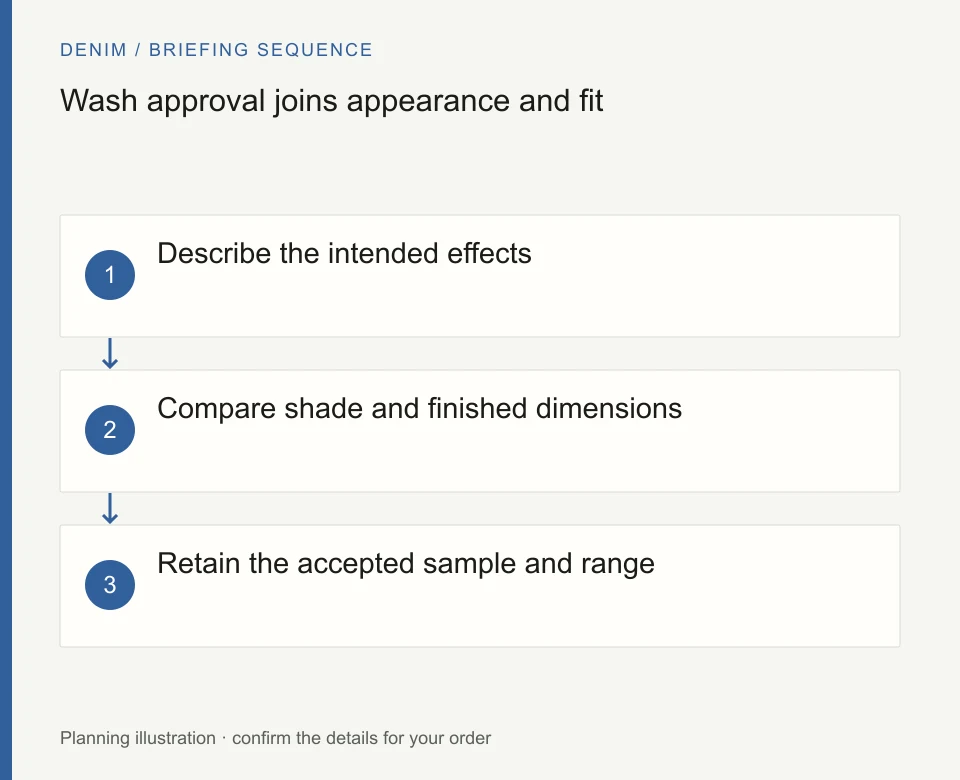
At a glance
Swipe the table sideways to compare both columns →
| Decision | What to specify | What to verify |
|---|---|---|
| Appearance | Overall tone and localized contrast map | Identify wanted effects and exclusions. |
| Fit | Measurements after the intended production finish | Do not mix this baseline with later care results. |
| Acceptance | Physical master and any agreed range | Record specific changes and the final governing version. |
Annotate the appearance target
Mark overall body shade, thigh contrast, whisker direction, seam highlights and any distressed areas on reference images. State which effects are essential and which should be omitted. A wash name such as vintage covers many possible appearances and does not identify the manufacturing method. Ask the supplier to propose a route for the actual fabric rather than assuming the image proves a process.
Include front, back and close-up views, plus a physical reference when the shade is important. Specify whether abrasions are surface effects or intentional openings, and avoid copying decorative marks without understanding their placement. The aim is a coherent garment brief. It is not to claim that a particular visual treatment produces verified strength, comfort or durability without relevant evidence.
Review shade and dimensions under stated conditions
Compare the finished sample with the controlling reference under agreed lighting and consistent orientation. Review broad tone separately from local contrasts at pockets, seams and hems. Use photographs to identify locations, not as the only color standard. Phone exposure and screen differences can make a sample appear lighter, warmer or more contrasted than the physical garment.
Measure the approved points after the intended production finish and record hand feel and shape. Check rise, waist, seat and leg lengths rather than only the inseam. If a later care trial is required, document it as a separate procedure with its own baseline. A production wash is not proof that consumer care will cause no further dimensional or shade change.
Make revision and bulk acceptance explicit
Write numbered comments that distinguish retain, revise and confirm. For a shade issue, identify overall tone or a localized effect; for fit, identify the measurement or worn behavior. Avoid instructions such as more vintage that leave the supplier to change several features at once. Where variation is expected, agree how acceptable boundaries will be represented and reviewed before bulk production.
Retain the accepted sample with material identity, version and approval date, along with any boundary references. Update the tech pack and record how trims and decoration relate to the finishing sequence. If a new fabric is proposed later, reopen the relevant wash and fit checks. The prior sample remains a target, but it does not prove the new material will finish identically.
Send these details together
- Annotated front, back and detail references
- Actual fabric identity and sample version
- Consistent physical shade review conditions
- Finished measurements and consolidated comments
- Accepted sample and agreed variation boundaries
Use this checklist to prepare your own order brief. Materials, processes, acceptance criteria and any applicable product requirements need order-specific confirmation; this guide is not a test report or availability guarantee.
Prepare a quote briefThe RFQ form prepares a WhatsApp message for you to review. For files, email sales@denimmanufacturerchina.com.
Questions before sampling
What are your MOQ, sample time and bulk lead time?
MOQ is 100 pcs. Samples take 7 days. Bulk production lead time depends on order quantity.