How to Brief a Carpenter Jeans Manufacturer for OEM
Briefing a carpenter jeans manufacturer starts with defining whether the garment is utility-inspired casualwear or intended to carry specified tools during use. Translate that purpose into pocket positions, hammer loop dimensions, reinforcement details, fabric requirements, and a relaxed or straight fit block with measurable tolerances. Confirm MOQ 100 pcs per color per design separately from fabric and hardware minimums. Samples take approximately 7 days once the brief and materials are confirmed, while bulk timing depends on quantity, material readiness, wash development, and approvals. Release production only after reviewing actual-fabric samples for access, movement, post-wash measurements, and attachment performance.
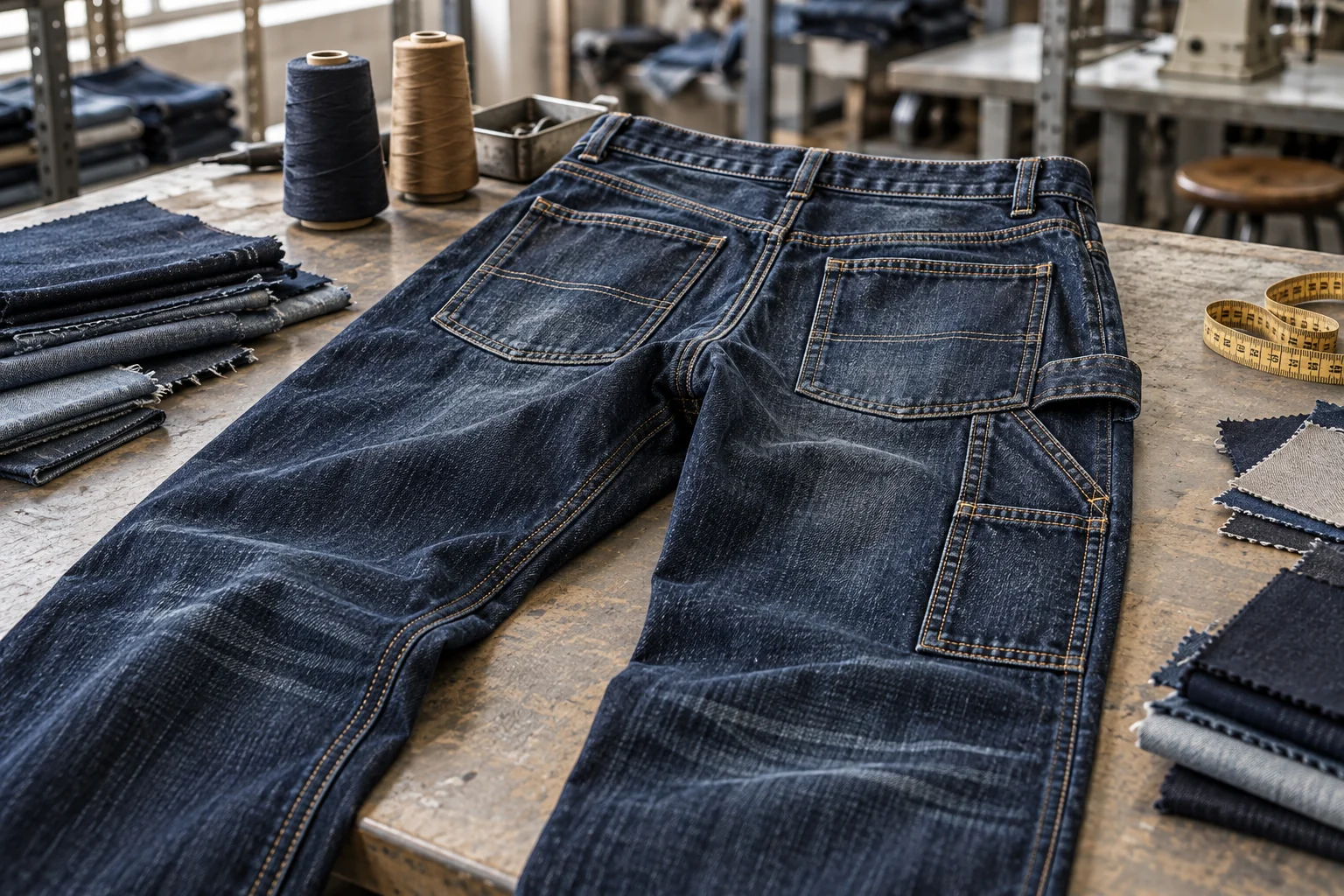
At a glance
Swipe the table sideways to compare both columns →
| Briefing point | Evidence to request | Approval control |
|---|---|---|
| Intended use and fit | Use description, measurement chart, and movement review | Separate utility styling from agreed carrying requirements |
| Hammer loop and tool pockets | Dimensioned placement drawing and actual-item access trial | Approve finished openings, orientation, and attachment points |
| Fabric and reinforcement | Identified denim, seam details, and layered construction sample | Check strength requirements alongside mobility and sewing feasibility |
| Wash and hardware | Finished sample with exposed pocket bags and hardware inspection | Reject unapproved damage or substitutions before bulk release |
| Production handoff | Approved sample, revision log, and inspection instructions | Link bulk cutting and washing to the same controlled specification |
1. Give the carpenter jeans manufacturer a defined use case
Start the brief with the intended wearer, selling channel, and realistic use of the garment. A casual carpenter jean with decorative utility details needs a different approval basis from jeans expected to hold particular tools through repeated movement. List the items to be carried, their relevant dimensions, and whether the wearer needs access while standing, sitting, or kneeling. If carrying performance matters, provide representative items or agreed substitutes for sample evaluation rather than asking for strong pockets without a defined condition. State which features are functional, which are visual, and which claims the product will make. Do not treat a hammer loop or reinforced seam as evidence of protective performance. Ask the China OEM to identify pattern, sewing, laundry, and inspection responsibilities, including any subcontracted operations that could affect the agreed construction or finishing route.
Build the technical package around a numbered front, back, and side drawing instead of relying on a reference photograph alone. Mark the hammer loop side, tool pocket arrangement, side utility pockets, back pocket relationship, and any reinforcement visible on the outside. Include a bill of materials, measurement chart, stitch and thread requirements, hardware schedule, and revision date. Where the supplier must propose a detail, label it as an open development point with an approval owner, not as permission to choose freely in bulk. Request a feasibility review that flags crowded seam intersections, inaccessible sewing areas, and details likely to change after washing. Keep commercial assumptions beside the technical brief: MOQ 100 pcs per color per design, size allocation, packaging requirements, and separately quoted material commitments. This gives purchasing and development teams the same basis for comparing the proposal.
2. Dimension hammer loops, tool pockets, and side storage
Locate each utility feature from stable garment references, such as the waistband seam, side seam, or another clearly identified construction line. Specify whether distances are measured before or after washing and whether the garment is laid flat without tension. For the hammer loop, show finished strip width, usable internal opening, orientation, and the position of both attachment ends. Distinguish the strip's cut length from the finished clearance available to the intended item. Ask for a side-view photograph and a physical access trial because a loop can look correct when flat but twist or collapse when worn. Review whether the attachment is caught into an existing seam, secured to a pocket, or supported by a separate reinforcement. State acceptable projection from the leg and assess likely snagging during the intended activity. Do not assume that a larger loop automatically improves usability.
For tool pockets, dimension usable width and depth inside the finished pocket rather than only the visible panel. Identify the opening direction, hem or binding construction, divider positions, and any layered compartments. Compare those dimensions with the actual items and allow the development team to check access without forcing the opening or distorting the leg. Side utility pockets also need a relationship to the knee, seat, back pocket, and side seam, particularly on smaller sizes where features can crowd together. Specify whether placement stays fixed across sizes or follows an agreed grading rule. Test both empty and occupied pockets during sitting and walking, looking for pressure points, items slipping out, and openings blocked by another panel. Record the approved arrangement in a placement table with tolerances. Any proposed left-right reversal or altered pocket depth should return for approval rather than being treated as a sewing convenience.
3. Match denim weight and reinforced seams to the brief
Select fabric weight alongside weave, composition, usable width, handfeel, and the intended finishing route. Heavier denim may provide the desired structure, but weight alone does not establish resistance to abrasion, tearing, or repeated pocket loading. Ask the supplier to identify the fabric article and explain the evidence available for the buyer's intended use. If additional testing is required, agree the method, sample condition, and acceptance criteria before ordering it. Review a layered construction sample at the loop attachment, utility pocket mouth, and side seam to see whether the chosen material creates excessive bulk. For stretch denim, assess recovery and local distortion around loaded features rather than relying only on elastane content. For rigid denim, consider mobility and break-in expectations within the selected fit. Keep alternative fabrics separate in the quotation because changes in width, shrinkage, and thickness can affect consumption and construction.
Specify reinforced seams by location and construction instead of requesting double stitching everywhere. Identify the seam type, seam allowance, stitch rows, thread requirements, and how exposed edges are finished. Mark stress points at pocket openings, divider ends, loop attachments, and the base of loaded compartments. Ask the factory to propose reinforcement that spreads the expected load without creating an uncomfortable hard spot or an unnecessarily perforated fabric area. Bar tacks, backing patches, rivets, and folded layers serve different purposes and should not be treated as interchangeable decorative choices. Review stitch balance and skipped stitches where multiple layers meet, including the reverse side of the garment. If an attachment evaluation is needed, agree the load direction, conditioning, procedure, and acceptance criteria with a competent testing provider or the factory's quality team. Preserve the approved construction details in the technical package so a later sewing adjustment does not silently remove reinforcement.
4. Qualify washing without sacrificing pocket bags or hardware
Separate the target wash appearance from the permitted effect on functional components. Provide an appearance reference and identify zones where abrasion, holes, thinning, or aggressive edge wear are not acceptable, including loop anchors, pocket mouths, pocket bag seams, and reinforcement patches. Ask the laundry team to review the complete garment rather than a denim panel alone, since pocketing, thread, labels, and hardware may respond differently to the same process. State whether any distressing is decorative and keep it away from areas expected to retain carried items unless that construction has been specifically evaluated. Require samples in the intended denim and pocketing materials, with the proposed operation sequence recorded. A visually successful wash is not sufficient evidence of usable pockets. Review whether the finish leaves residue, excessive stiffness, or rough internal edges that could affect access or wearer comfort before approving the route.
Turn the finished sample inside out and inspect pocket bags for thinning, holes, seam opening, distortion, and damage where they rub against hardware or reinforced seams. Compare the intended pocket capacity before and after finishing, and check whether shrinkage differences pull openings out of shape. Specify pocketing composition, construction, and the evidence needed for durability rather than accepting a generic description such as heavy pocket fabric. For hardware, identify each component, dimensions, finish, backing arrangement, and installation stage relative to washing. Check zipper operation, button security, rivet placement, sharp edges, and unwanted contact with the wearer or carried objects. Ask whether the wash can alter the finish or expose underlying material, then approve the actual appearance range. Record any required market-specific chemical or product compliance checks separately. Do not allow an available rivet or lighter pocketing substitute to enter production without reviewing compatibility with the approved garment.
5. Review the fit block through staged garment samples
Choose the fit block explicitly rather than assuming carpenter jeans must use one universal relaxed shape. A relaxed or straight silhouette is common, but the brief still needs waist, rise, seat, thigh, knee, and hem measurements with defined measurement methods and tolerances. Include intended wearing position and the size of the fit model or agreed evaluation form. Assess whether the front rise and seat permit sitting and bending without pulling loaded side pockets into the body. Review knee movement, pocket accessibility, and the way loop attachments affect the side seam line. The useful question is not only whether the sample looks loose enough, but whether the intended wearer can move and reach the specified storage. Keep fit approval separate from permission to change utility feature dimensions. A wider leg does not automatically justify a larger tool pocket, and a smaller waist size may need its own placement review.
Use sample gates that separate unresolved pattern decisions from final production authorization. First review layout and construction feasibility, then evaluate an actual-fabric sewn sample, and finally approve the finished garment with the proposed wash and hardware. These reviews may use fewer physical samples when the route is straightforward, but record what each approval covers and what remains open. Samples take approximately 7 days once the brief and materials are confirmed; unavailable trims, wash trials, shipping, and revisions require separate planning. Measure after the agreed finishing and conditioning steps, inspect internal construction, and conduct the specified movement and carrying reviews. Request size-set checks where grading or pocket crowding presents a risk, particularly at the range limits. Maintain a revision log linking comments to pattern, material, and wash versions. Do not approve bulk cutting against a fit sample that still uses substitute pocketing or unconfirmed utility attachments.
6. Link bulk release to construction and inspection records
Convert the final approval into a production file containing the sealed reference sample, current technical package, bill of materials, placement table, and wash reference. Confirm MOQ 100 pcs per color per design and show the size split for each approved version. Ask whether fabric, custom hardware, pocketing, or special finishes introduce separate purchasing minimums or surplus commitments. Make the cost responsibility and ownership of unused materials visible before the purchase order is released. Bulk timing depends on quantity as well as material availability, sewing capacity, laundry scheduling, and approval closure. Request a milestone plan covering material receipt, cutting authorization, early sewing review, washing, and final inspection rather than accepting a shipment date without dependencies. Identify who can authorize changes and require written review of substitutions. If the manufacturer proposes moving a loop attachment or simplifying a reinforcement for production, compare the change with both the approved appearance and functional requirement.
Build inspection instructions around defects that could be missed in a general appearance check. Include pocket position and usable opening measurements, loop orientation and attachment integrity, reinforcement presence, internal bag condition, and hardware operation after washing. Define how garments will be selected for review and agree defect categories and acceptance rules with the responsible inspection party. Check early production before the entire order reaches the laundry, then compare finished output with the approved sample under consistent viewing conditions. Where an agreed test is destructive, reserve suitable garments and clarify whether testing occurs before shipment release. Track failures to the relevant operation rather than repairing visible symptoms without investigating the cause. Retain records of material identity, pattern version, wash batch, and corrective action where applicable. For repeat orders, reconfirm material availability and inspect new-lot behavior; an unchanged style name does not establish that the original approval still represents current production.
Send these details together
- Define intended use, carried items, functional claims, and the approved relaxed or straight fit block.
- Dimension hammer loops, tool pockets, and side utility pockets from named reference points with grading rules.
- Identify denim, pocketing, seam construction, reinforcement locations, and any agreed performance evaluation.
- Approve the actual wash and hardware combination after inspecting internal bags and attachment areas.
- Close fit, movement, placement, size-set, and post-wash sample comments before bulk cutting.
- Confirm MOQ 100 pcs per color per design, separate material commitments, production milestones, and inspection ownership.
This guide covers buyer-side briefing of carpenter and utility jeans for China menswear OEM production, including storage features, fabric, reinforced construction, finishing, fit, and approval controls. It does not establish protective clothing performance or replace product-specific testing and market compliance review. MOQ 100 pcs per color per design is the starting garment requirement; confirm separate material minimums. Samples take approximately 7 days once the brief and materials are confirmed; bulk timing depends on quantity, materials, capacity, and approvals. Reprint attribution: denimmanufacturerchina.com.
Prepare a quote briefThe RFQ form prepares a WhatsApp message for you to review. For files, email sales@denimmanufacturerchina.com.
Questions before sampling
Which side should the hammer loop be on?
Specify the side from the wearer's perspective and confirm it on a labeled drawing. Placement should follow the intended use, access preference, and relationship to nearby pockets rather than an assumed universal rule. Review the finished loop with the intended item while worn. If both left and right versions are needed, identify them as separate configurations and confirm production allocation.
Does heavier denim automatically make better carpenter jeans?
No. Weight affects structure and bulk, but it does not establish the durability of the complete garment. Consider weave, yarn characteristics, finishing, seam construction, pocketing, and reinforcement together. Ask for relevant material evidence and evaluate the actual garment against agreed use conditions. A heavier fabric can also create difficult seam intersections or restrict movement if the pattern and construction are not adjusted.
Can carpenter jeans use a heavily distressed wash?
They can be developed with that appearance, but the brief should define where damage is prohibited and what functional requirements remain. Review actual-fabric samples for thinning around loop anchors, pocket mouths, bags, and reinforced seams. If the finish conflicts with carrying requirements, revise the wash or construction before approval. A visual reference alone cannot establish whether the finished pockets remain suitable.
What must be approved before bulk production starts?
Approve the current pattern, materials, utility placements, reinforcement details, hardware, and finished wash reference, with unresolved comments closed in writing. Check post-wash measurements and the agreed movement and carrying conditions. Confirm the size allocation, material commitments, and inspection plan. If a sample used substitute materials, identify the remaining approval gate rather than treating that sample as full authorization for bulk cutting.
What are your MOQ, sample time and bulk lead time?
MOQ is 100 pcs. Samples take 7 days. Bulk production lead time depends on order quantity.