Work With a Jeans Manufacturer: Brief, Sample, Bulk Gates
Working with a China jeans OEM factory is a sequence of documented approvals, not simply sending a reference photo and accepting a price. Start with a clear product brief, confirm fabric and measurement requirements, review fit and wash separately where practical, and approve a pre-production sample before releasing bulk. Our MOQ is 100 pcs, and samples take approximately 7 days once the brief and materials are confirmed. Bulk timing depends on quantity and the agreed production requirements. This guide explains what buyers should submit, what to record at each approval stage, and how to preserve specifications for consistent reorders.
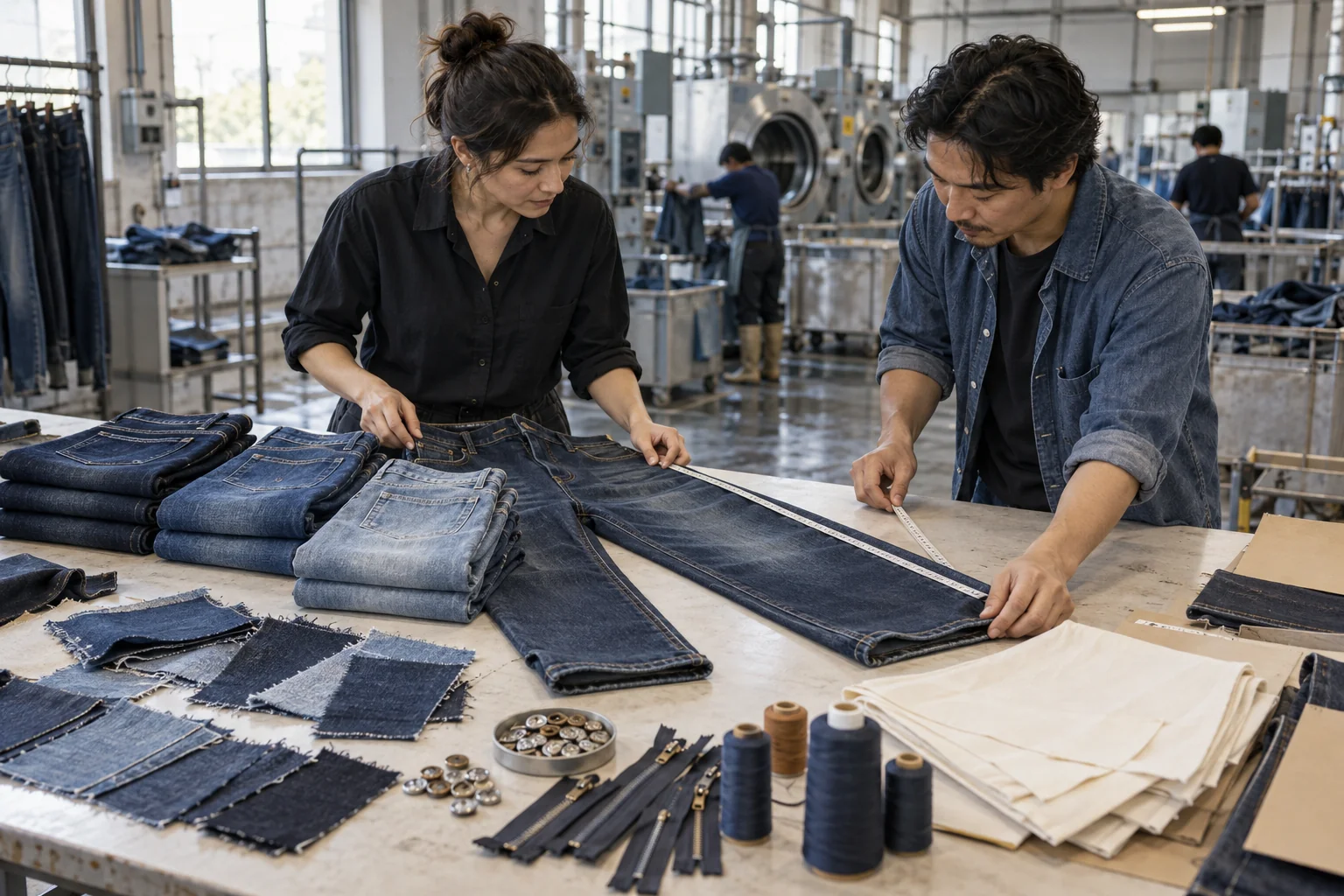
At a glance
Swipe the table sideways to compare both columns →
| Working stage | What to confirm | Sample or bulk check |
|---|---|---|
| Brief and quotation | Style references, fabric requirements, size range, quantity, target market, and delivery basis | Check quotation assumptions, MOQ 100 pcs, and unresolved material or trim details |
| Fit development | Measurement chart, points of measure, tolerances, grading, and intended wearing ease | Measure the sample consistently and issue consolidated fit comments |
| Wash and hardware approval | Wash appearance, acceptable shade band, finishing details, buttons, rivets, and zipper | Compare physical references and record approved finish and placement |
| Pre-production approval | Final fabric, construction, measurements, wash, labels, packing, and specification revision | Approve the PP sample in writing and close any exceptions before bulk release |
| Bulk and reorder control | Inspection arrangements, packing records, retained references, and material availability | Check production against approved standards and review changes before reordering |
1. Build a brief the factory can quote and sample
Begin with a brief that connects the commercial requirement to a producible garment. Tell us the jeans category, intended wearer, silhouette, size range, quantity, destination market, and requested delivery window. Include front and back drawings, detail photographs, and a physical reference garment when available, but identify which features are references rather than instructions to copy. Specify fabric composition, desired weight, stretch behavior, color direction, and hand feel, or ask the factory to propose available options. Our MOQ is 100 pcs; confirm how your proposed style, wash, color, and size assortment fits the quotation rather than assuming every variation can share that minimum.
Attach a measurement chart with named points of measure, measurement methods, sample size, size grading, and proposed tolerances. Add seam details, stitch appearance, pocket construction, belt loops, labels, hardware, and packing expectations. If a requirement is undecided, mark it as open and assign responsibility for resolving it. For companion reading, How to Brief Custom Made Men's Jeans explains how to turn a menswear concept into practical development instructions, while How to Compare Jeans Manufacturers in China supports supplier evaluation. Ask for a quotation that identifies included processes, sampling costs, material assumptions, delivery terms, and exclusions. A clear quotation prevents an apparently comparable price from concealing a different fabric, wash process, or packing scope.
2. Review fit with a controlled measurement chart
Samples take approximately 7 days once the brief and materials are confirmed. Treat this as a development estimate, not a promise that sourcing, courier transit, buyer review, and every revision are included. Before sampling starts, confirm which fabric and trims will be used and whether any substitute is proposed. A substitute can help evaluate construction, but it may not represent final stretch recovery, drape, shrinkage, or wash appearance. When the sample arrives, measure it using the agreed methods and record the garment condition, including whether it has received the intended wash. Compare actual measurements with the chart instead of relying only on the tagged size.
Evaluate fit on a suitable wearer or fit form and keep that reference consistent across revisions. Review waist position, front and back rise, seat balance, thigh ease, knee placement, leg shape, and inseam together because changing one area can affect another. Send one consolidated comment sheet with annotated photographs, measured differences, requested changes, and a revised chart where necessary. Separate construction defects from fit preferences and avoid conflicting instructions from different reviewers. If grading has not been checked, request an agreed size-set review before approving the whole range. From the factory side, a dated, numbered revision is more actionable than scattered messages saying the jeans should feel slightly slimmer or more relaxed.
3. Approve wash, hardware, and the pre-production sample
Define wash approval through physical references wherever practical. Photographs help communicate direction, but lighting, screens, and camera processing can obscure shade and contrast. Record the intended base shade, fade placement, whisker effect, abrasion intensity, distressing positions, and hand feel. Agree an acceptable wash shade band that shows the boundaries you will accept, rather than assuming every garment will look identical to one sample. Confirm how those references will be labeled, retained, and used during bulk checks. How to Brief Washed Denim Programs is useful companion reading for buyers developing several finishes. Ask the factory to flag wash changes that may affect measurements, fabric strength, appearance, or production timing before approving the final process.
Approve hardware and the pre-production sample, commonly called the PP sample, against the final specification pack. Check button and rivet design, finish, attachment positions, zipper operation, labels, pocketing, seam construction, and any branded details. Confirm whether the PP sample uses the intended bulk fabric, trims, and wash process, and document any exceptions explicitly. An exception is not automatic permission to substitute materials during production. If testing or certification is required for your market or purchasing policy, specify the applicable requirements and request relevant documentation; do not infer compliance from sample appearance. Release bulk only after the authorized buyer records approval and outstanding issues are resolved or covered by a clearly agreed written action.
4. Control bulk production, packing, and reorders
Bulk timing depends on quantity, with the schedule also influenced by material availability, wash complexity, approval status, and packing requirements. Ask the factory for a production plan after the final requirements are settled, and identify milestones for material readiness, cutting, sewing, washing, finishing, and shipment preparation. Agree when progress updates and inspections will occur, who can authorize corrective action, and which checks must be completed before shipment release. Use the approved measurement chart, PP sample, wash shade band, and trim references as the inspection basis. If you require an independent inspection, define its scope and acceptance criteria in advance rather than introducing unfamiliar requirements after goods are packed.
Packing deserves the same revision control as garment construction. Confirm folding method, individual packaging, size stickers, barcode content, carton markings, assortment ratios, carton limits, and any destination-specific labeling requirements. Request suitable packing evidence and reconcile carton quantities with the agreed order before shipment release. For reorders, retain the final specification pack, approval correspondence, physical wash references, and representative production samples. Ask whether the original fabric and hardware remain available and whether a new fabric lot or changed process requires fresh approval. A repeat style number does not guarantee an identical shade or fit without verification. Record any approved reorder changes so both buyer and factory work from the same current standard.
Send these details together
- Submit a complete brief covering silhouette, fabric, quantity, size range, target market, and delivery expectations. Confirm how the assortment meets MOQ 100 pcs and list every unresolved quotation assumption.
- Issue a revision-controlled measurement chart with points of measure, grading, and agreed tolerances. Review sample measurements and wearer fit together, then return one consolidated set of development comments.
- Approve physical wash references, the acceptable shade band, hardware, and labels. Record which materials are final and which sample components remain temporary or require separate approval.
- Authorize bulk against the approved PP sample and final specification pack. Confirm the quantity-dependent schedule, inspection arrangements, packing instructions, and responsibility for approving any production changes.
- Retain approval records and representative references for reorders. Reconfirm fabric and trim availability, check changes between material lots, and agree whether new sampling is needed before repeat production.
This informational buying guide covers working with a China jeans OEM factory from briefing through fit, wash, PP approval, bulk checks, packing, and reorders. MOQ is 100 pcs; samples take approximately 7 days once the brief and materials are confirmed, and bulk timing depends on quantity. It does not establish verified lab performance, certification status, or destination-market compliance. Reprinting is permitted with attribution to denimmanufacturerchina.com and sales@denimmanufacturerchina.com.
Prepare a quote briefThe RFQ form prepares a WhatsApp message for you to review. For files, email sales@denimmanufacturerchina.com.
Questions before sampling
What should I send a jeans manufacturer before requesting a quote?
Send style drawings or reference images, fabric requirements, a size range, a measurement chart if available, quantities, wash direction, hardware details, branding, packing needs, and the delivery destination. Explain which details are fixed and which need factory recommendations. Ask the factory to state any assumptions in its quotation. Our MOQ is 100 pcs, but the proposed distribution across styles, washes, colors, and sizes still needs confirmation before the quote becomes a reliable production basis.
How long do jeans samples and bulk production take?
Samples take approximately 7 days once the brief and materials are confirmed. Clarify the starting point and whether the quoted timing includes the requested wash and trims; sourcing, shipping, buyer feedback, and additional revisions can extend the overall development calendar. Bulk production timing depends on quantity and the agreed requirements. Request a schedule based on confirmed materials, completed approvals, and packing details rather than treating sample timing as an indication of bulk lead time.
What must be approved before jeans bulk production starts?
Approve the final specification revision, measurement chart, fabric, fit, wash reference and shade band, hardware, labels, and packing instructions. Review the PP sample and confirm that it represents intended bulk materials and processes, with any exceptions documented and resolved through an agreed action. Establish inspection criteria and change-approval responsibilities. If your order needs testing or certification evidence, define those requirements separately and verify the relevant documentation instead of assuming a PP sample proves compliance.
What are your MOQ, sample time and bulk lead time?
MOQ is 100 pcs. Samples take 7 days. Bulk production lead time depends on order quantity.