How to Choose a Denim Manufacturer
Choose a denim manufacturer by verifying how the factory turns your fit brief, fabric requirements, wash reference, and trim specification into repeatable finished jeans. For brand buyers sourcing China jeans OEM, the strongest selection process is a controlled comparison of technical capability, material availability, sample execution, and quote scope, not a directory search ranked by the lowest unit price. This guide covers garment OEM rather than denim fabric milling. Plan around an MOQ of 100 pcs, samples in approximately 7 days once the brief and materials are confirmed, and bulk timing that depends on quantity and the agreed production requirements.
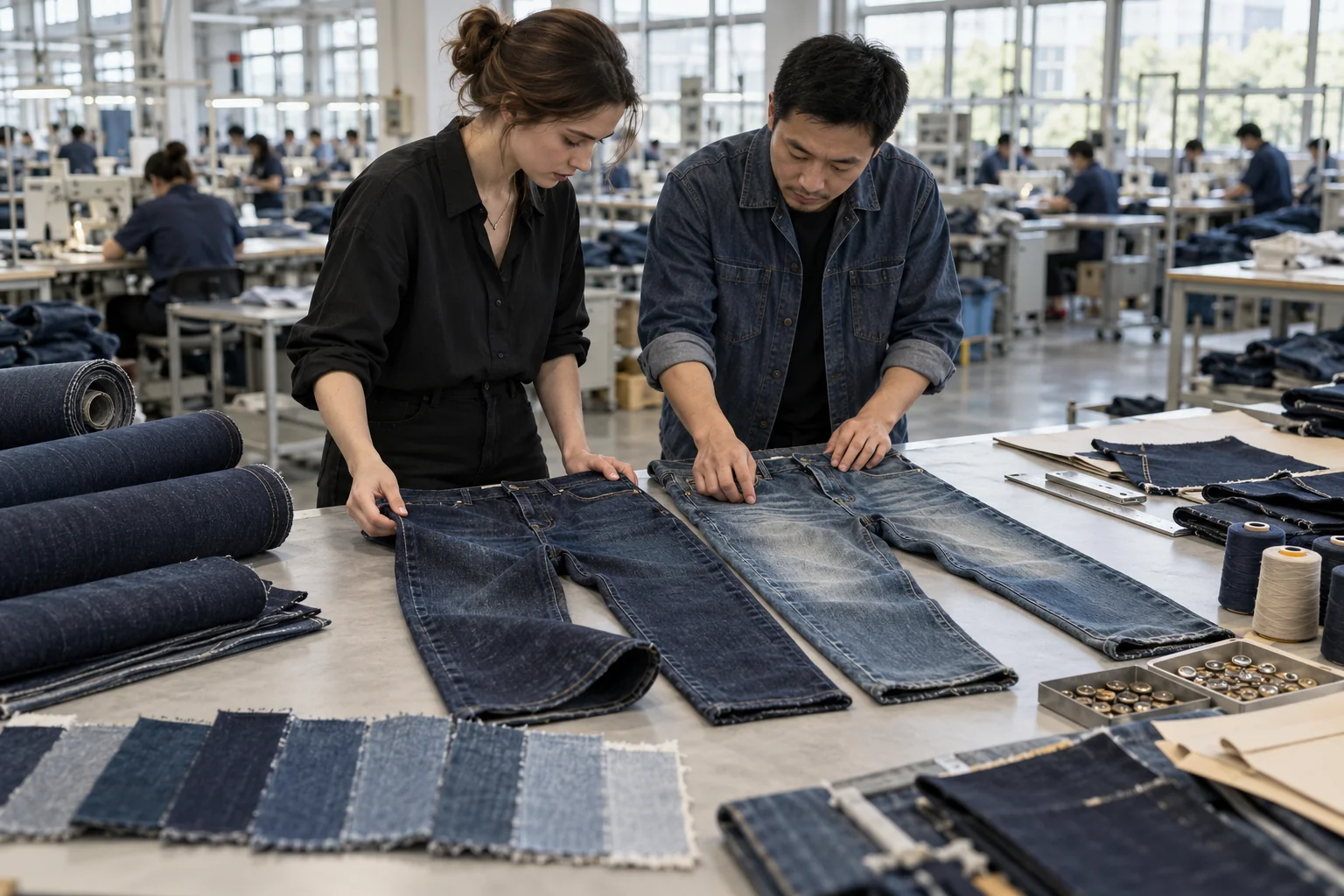
At a glance
Swipe the table sideways to compare both columns →
| Choose factor | What to verify | Red flag |
|---|---|---|
| Fit and pattern capability | Measurement methods, base pattern development, grading, tolerances, and fit approval after washing. | A size chart is accepted without questions about fit, fabric behavior, or measurement points. |
| Fabric sourcing path | Stock or custom-mill route, available quantity, composition documentation, shade continuity, and replenishment options. | Fabric is described only by weight or color, with no identifiable source or availability confirmation. |
| Wash and finish control | Reference interpretation, development steps, acceptable appearance variation, and responsibility for outsourced processes. | A reference photo is treated as a guarantee of an identical result on any denim. |
| Hardware and trims | Specifications, supplier availability, customization requirements, attachment methods, and approval responsibilities. | Unapproved substitutions or unspecified branded hardware are included in the offer. |
| Sample and quote discipline | Confirmed brief, sample scope, revision process, MOQ allocation, itemized pricing assumptions, and bulk scheduling basis. | A low headline price omits wash development, trims, packaging, or other required work. |
1. Define the garment OEM scope and prove fit capability
Start by specifying the finished garment you need, rather than asking whether a supplier makes denim. A garment OEM should be able to explain its responsibility for pattern development, cutting, sewing, wash coordination, trim application, finishing, and packing. It may purchase fabric from a mill or distributor without operating a denim mill itself. Ask which processes are handled internally, which are subcontracted, and who manages approvals across those handoffs. Provide your target customer, silhouette, intended size range, reference garment, and key construction details. A useful response should identify missing inputs and practical constraints, not simply confirm that every request is possible.
Assess fit capability through the factory's proposed development process. Ask how it establishes measurement points, creates or adapts the base pattern, accounts for fabric stretch and wash shrinkage, and grades the approved fit into the remaining sizes. Specify which measurements are critical, such as waist, front rise, back rise, thigh, knee, and leg opening, and agree how each is measured. Review fit on the intended body or an agreed fit model, not only on a flat table. The companion guide How to Design Your Own Jeans with a Factory helps structure the brief before sampling. Treat similar product photos as background evidence, not proof that your fit can be reproduced.
2. Verify the fabric sourcing path and material constraints
Separate the garment MOQ from the minimums and availability attached to individual materials. Use 100 pcs as the garment MOQ for this sourcing brief, then confirm whether that quantity applies per style, wash, color, or another agreed allocation. Ask the manufacturer to identify a realistic stock-denim route and, if relevant, a custom-mill alternative. Stock fabric may simplify initial sourcing, but buyers still need to verify usable quantity, shade consistency, composition, width, weight, and the likelihood of replenishment. Custom development can introduce separate mill minimums and additional lead time. How to Choose Stock Denim vs Custom Mill provides companion reading for choosing between those sourcing paths.
Evaluate fabric as part of a finished-jeans system, not as an isolated swatch. Request identifiable fabric references and compare handfeel, stretch behavior, recovery expectations, surface character, and response to the intended wash. Ask how the factory will check dimensional changes before finalizing the pattern and what happens if the approved fabric becomes unavailable. Record whether substitutions require written buyer approval. If composition, restricted-substance requirements, or a certification claim matters to your market, request relevant documentation and verify its issuer, scope, validity, and relationship to the actual material or facility. Do not assume a garment factory's statement establishes compliance, and do not treat an unverified document as a finished-product guarantee.
3. Evaluate wash execution, finishing, and hardware
Translate your wash reference into observable requirements before judging a factory's finish range. Identify the desired base shade, contrast, abrasion placement, whisker character, softness, and any distressing that affects garment strength or appearance. Ask which effects the proposed fabric can support and which require development rather than direct copying. A photograph is useful for direction, but lighting, fabric construction, and finishing differences can change the result. Request a physical approval sample where appearance is commercially important, and agree how acceptable variation will be reviewed in bulk. If washing is outsourced, establish who communicates the recipe requirements, checks consistency, and takes responsibility for resolving deviations.
Review hardware and trims with the same discipline as fabric and wash. Specify zipper type, button and rivet appearance, back-patch material, pocketing, sewing thread, labels, and packaging requirements. Ask whether the quote uses stock components or custom-developed items, and confirm any separate minimums, tooling charges, and availability constraints. Establish when trims are attached in relation to washing and how the factory checks that their appearance and function remain suitable after finishing. Do not assume that branded components are included unless the supplier and specification are documented. Approve substitutions in writing and keep a trim reference with the garment sample so purchasing and production teams work from the same requirements.
4. Control sampling and compare quotes on an equal basis
Use sampling to test communication and technical execution, not just to obtain a sales sample. Samples are expected in approximately 7 days once the brief and materials are confirmed; clarify what sample stage that estimate covers and whether custom trims, special washes, or unresolved sourcing affect the schedule. Agree which specifications the sample must represent and list any temporary substitutions before work begins. Review measurements, construction, appearance, hardware, and finishing against the brief, then send consolidated comments with clear approval or revision decisions. Keep dated versions of the technical pack and sample comments. A factory that records deviations and asks precise questions is easier to manage than one that makes undocumented changes.
Compare quotes only after aligning the specification and commercial assumptions. Request the same fabric reference, wash scope, trim package, size breakdown, packaging, quantity, delivery term, and inspection expectations from each candidate. Separate sample charges, development work, tooling, and transport from the unit price where applicable, and clarify payment terms and responsibility for corrective work. How to Compare Jeans Manufacturers China offers companion reading for building this comparison without turning selection into a lowest-price contest. Bulk timing depends on quantity, material readiness, process requirements, and production scheduling, so request a milestone plan rather than an unconditional delivery promise. Place the order only after approval responsibilities, change control, and the production reference are documented.
Send these details together
- Issue one consistent brief covering fit, measurement methods, size range, fabric direction, wash reference, trims, packaging, and the intended approval process before requesting comparable quotations.
- Confirm the MOQ of 100 pcs and its allocation rules, then identify separate material, wash, or custom-trim constraints that could affect the proposed order.
- Verify fabric availability and traceable references, agree substitution controls, and request relevant supporting documentation without assuming that a supplier claim proves compliance.
- Confirm the approximately 7-day sample window starts only after brief and material confirmation, and document sample-stage limitations, review criteria, and revision responsibilities.
- Approve a defined production reference and compare complete quote scopes, payment terms, inspection arrangements, and quantity-dependent bulk schedules before committing to the factory.
This BuyingResource is an informational selection method for brand buyers evaluating China garment OEM suppliers for finished denim jeans, not a manufacturer directory, fabric-mill ranking, certification endorsement, or delivery guarantee. Reprinting is permitted with attribution to denimmanufacturerchina.com and sales@denimmanufacturerchina.com.
Prepare a quote briefThe RFQ form prepares a WhatsApp message for you to review. For files, email sales@denimmanufacturerchina.com.
Questions before sampling
How can a brand verify that a denim manufacturer can deliver its intended fit?
Ask the factory to explain its pattern-development and grading process using your actual brief. Review a sample made with the intended fabric and wash, measure it using agreed measurement points, and assess it on the intended fit body. Record deviations and approve revisions before treating the sample as a production reference. A portfolio of jeans photographs can demonstrate style familiarity, but it does not replace this fit-validation process.
What MOQ and sample timing should buyers plan around?
Plan around an MOQ of 100 pcs and samples in approximately 7 days once the brief and materials are confirmed. Confirm how the MOQ is allocated across styles, washes, colors, and sizes rather than assuming unrestricted mixing. Ask what the sample estimate includes and whether material development or custom trims require additional time. Bulk production timing depends on quantity and the confirmed production requirements, so obtain a schedule for the specific order.
How should buyers compare denim jeans manufacturers with different prices?
Normalize the specification first, then compare the full commercial scope. Check that fabric, wash complexity, trims, sizing, packaging, delivery terms, and inspection expectations match. Identify excluded development charges and any proposed substitutions. Evaluate how each manufacturer handles technical questions, sample deviations, and approvals alongside price. A cheaper quotation is not directly comparable if it uses a different fabric, omits required finishing, or leaves sourcing and corrective-work responsibilities undefined.
What are your MOQ, sample time and bulk lead time?
MOQ is 100 pcs. Samples take 7 days. Bulk production lead time depends on order quantity.