How to Brief a Custom Denim Jacket Manufacturer
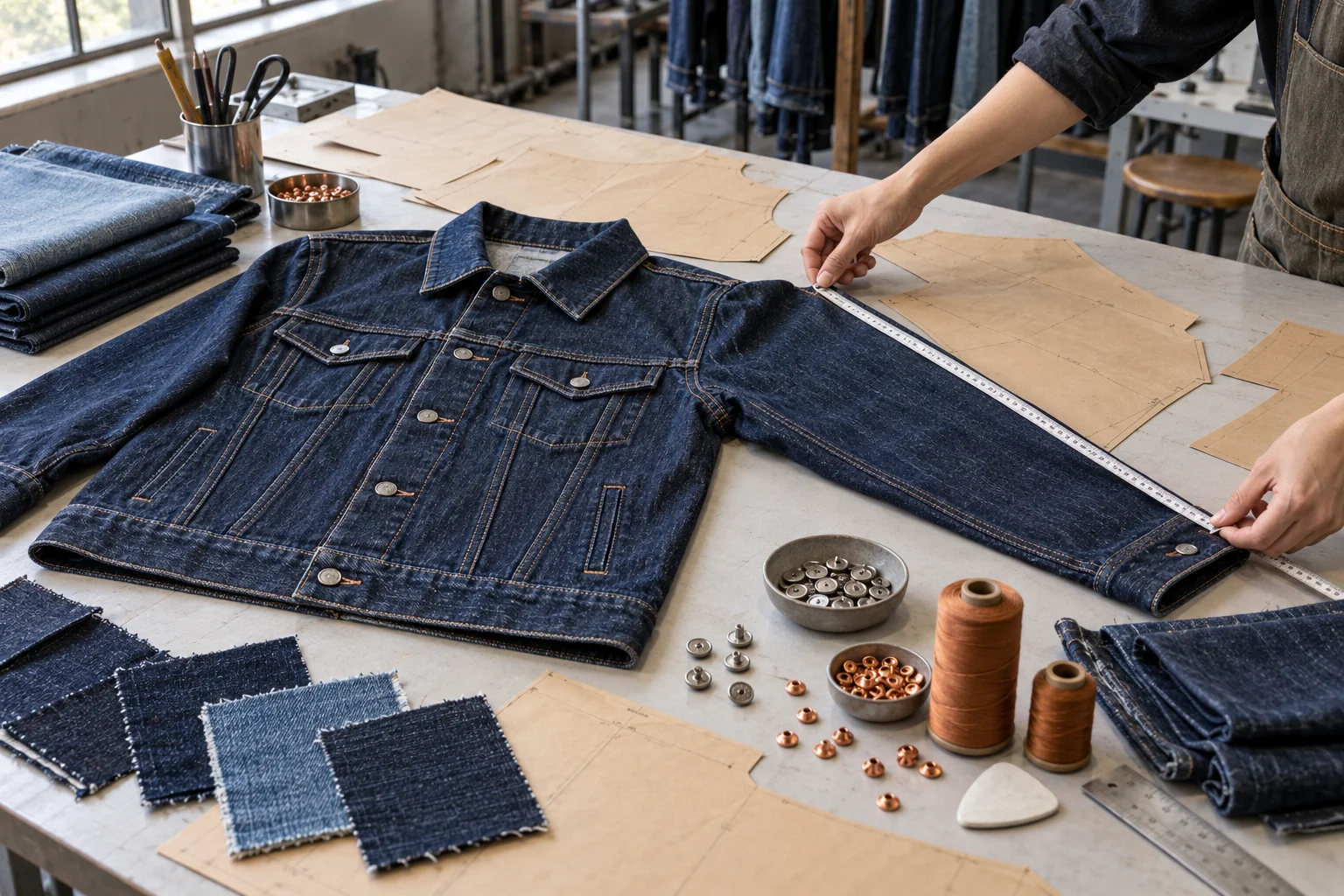
Briefing a custom denim jacket manufacturer starts with a defined jacket block, identified fabric, and finished measurements rather than a reference photograph alone. Specify pocket and yoke construction, hardware, topstitching, lining, and the intended wash as one production route. MOQ 100 pcs per color per design is the garment planning minimum; confirm separate fabric, lining, and hardware commitments. Samples take approximately 7 days once the brief and materials are confirmed, with additional time for sourcing, trials, shipping, or revisions. Bulk timing depends on quantity, material readiness, and approvals. Release production only after reviewing the actual-fabric jacket in its intended finished condition.
At a glance
Swipe the table sideways to compare both columns →
| Briefing point | Evidence to request | Decision or control |
|---|---|---|
| Jacket block and fit | Technical flats, measurement diagram, size chart, and fit photographs | Approve silhouette and movement without relying on a style nickname |
| Fabric and shrinkage | Identified article, weight, stretch behavior, and actual-route wash trial | Confirm pattern allowances against finished sleeve and body measurements |
| Pockets, yokes, and stitching | Construction drawings, seam details, and sewn intersection samples | Resolve pocket access, panel alignment, and bulky seam junctions |
| Hardware and lining | Shank and rivet references, attachment trials, lining specification, and assembly sequence | Check fastening, comfort, and component compatibility after finishing |
| Sample and bulk gates | Finished approval jacket, measurement report, material records, and inspection plan | Release each production stage against a traceable approved version |
1. Give the custom denim jacket manufacturer a defined block
Start with front and back technical flats, an intended wearer profile, and a written description of the silhouette. Broad Type I, Type II, and Type III references can help communicate a direction, but they do not identify a complete pattern. Describe the features instead: a single chest pocket with front pleats and a back adjustment detail; paired chest pockets with front pleats; or a shaped trucker front with angled panel seams and pointed pocket flaps. State which features you want to keep, remove, or combine. Identify body length, shoulder shape, sleeve volume, collar proportion, and hem treatment independently. A cropped, roomy jacket and a close-fitting trucker can share similar pocket styling while requiring different blocks. Ask the factory to mark any interpretation questions on the drawings before pattern development, rather than resolving them silently during sample sewing.
Build the measurement sheet around the finished jacket and show exactly how each point is measured. Include chest, shoulder, body length, hem opening, sleeve length, upper sleeve width, cuff opening, and collar dimensions, with tolerances agreed for each relevant point. Specify whether body length starts at the high shoulder point or another marked location, and whether sleeve length follows the outer sleeve from the shoulder seam. Record the sample size and proposed grading across the order. Explain whether the wearer should accommodate a shirt, sweatshirt, or heavier layer, since that affects chest ease, armhole shape, and movement. During fitting, assess reaching forward, bending the elbow, fastening the front, and using the pockets. Do not approve a jacket solely because its flat chest measurement matches the chart. Record fit comments against a pattern version so revisions remain traceable through washing and resampling.
2. Specify fabric weight, stretch, and the material commitment
Identify the denim article, supplier, composition, usable width, and weight in ounces per square yard or GSM. State the condition in which weight is reported and agree its tolerance, because an unfinished fabric figure is not directly comparable with a washed garment result. Describe the desired surface, stiffness, drape, and shade with labeled physical references where possible. For rigid denim, review whether the proposed weight and finish suit the intended jacket volume and seam build. For stretch denim, specify stretch direction and request an agreed assessment of extension and recovery; elastane content alone does not establish performance. Ask the factory to examine collar edges, pocket mouths, and long panel seams for distortion on the chosen article. If it suggests a substitute, require a separate comparison of width, handfeel, shrinkage, and sewing behavior before changing the bill of materials.
Separate the finished-garment order from the material purchase. MOQ 100 pcs per color per design does not establish that a mill will produce a custom denim article, special lining, or matching trim in the required quantity. Provide a size allocation and ask for consumption based on the actual usable width, pattern layout, and proposed shrinkage allowance. Identify allowances for defects, development, and cutting losses without counting the same requirement twice. Ask whether available stock is reserved for your program and whether sample yardage represents the intended bulk article and lot. Record fabric ownership, payment responsibility, and disposition of unused material. Where several colors or washes share a base fabric, confirm whether they can share a material booking without mixing shade groups in cutting. Obtain written approval before substitution, even when the alternative has the same nominal composition and weight.
3. Draw pocket, yoke, and topstitch construction explicitly
Show each pocket as a construction detail rather than a rectangle on the front view. Specify finished dimensions, placement from stable reference points, flap shape, opening direction, closure position, and whether the pocket is functional. For lower hand pockets, identify the pocket bag material, depth, securing points, and relationship to front panel seams. Check that a hand can enter without pulling against a chest pocket, hem band, or lining attachment. Draw the front and back yokes with their seam paths and state how they meet the armhole and center back. Mark pleats, tucks, adjustment tabs, and reinforcement locations separately. Ask for a sewn detail sample when several denim layers converge, especially at pocket corners, side seams, and waistband junctions. Review the inside as well as the outside, since a clean external line can conceal uncomfortable bulk or unsecured pocket bags.
Define the seam construction and visible stitch layout by location, including the collar, front opening, yokes, pockets, cuffs, and hem band. State the number of topstitch rows, their spacing, and their distance from the finished edge. Identify the thread reference, color, material, and size using the supplier's stated sizing system, then approve its appearance on the actual denim. A thick-looking contrast thread may behave differently at tight corners or multilayer intersections than it does on a flat swatch. Ask the factory to propose practical sewing settings and reinforce stress points without altering the intended appearance. Review seam puckering, skipped stitches, broken threads, and exposed raw edges after finishing. If the design requires deliberate irregularity or abrasion, define its location and limits. Do not let a distressed appearance become a general exemption for weak seams or inconsistent pocket placement.
4. Qualify shank buttons, rivets, and lining as a system
List every shank button and rivet by location, quantity, face size, finish, and approved reference. Distinguish front fastening buttons from cuff, pocket, and adjustment-tab hardware, even when they share an appearance. Ask the attachment supplier and garment factory to confirm suitable components for the actual fabric stack, including any interfacing or reinforcement. Require a trial on the intended construction rather than accepting loose hardware as proof of suitability. Check buttonhole length, direction, reinforcement, and fastening effort after washing. Inspect for sharp edges, rotation or looseness, backing discomfort, and damage to surrounding fabric under the agreed evaluation procedure. Confirm market-specific chemical or safety requirements with the buyer's compliance team and request applicable evidence without assuming a decorative finish is suitable everywhere. Document whether hardware is attached before or after washing and how that sequence affects appearance, attachment quality, and replacement handling.
For a lined or sherpa-style jacket, identify the lining composition, weight, pile characteristics where relevant, color, and coverage. State whether the body, sleeves, collar, and pockets use the same material or different materials. Specify the desired layering space and request a separate fit review if lining is added to a previously approved unlined block. Agree how the lining joins the armhole, front facing, cuffs, and hem, including movement ease and any accessible opening needed for assembly. Ask the factory to explain whether the shell is washed before lining insertion or the complete garment is finished together. Neither sequence should be assumed from photographs. Review the proposed route for differential shrinkage, shell dye transfer, pile matting, trapped bulk, and lining exposure at the hem. Approve the combined construction after its intended finishing process, with separate care-performance evaluation where required by the selling market.
5. Link wash shrinkage to sleeve length and body balance
Describe the intended wash through a physical reference, labeled photographs, and written limits for shade, abrasion, contrast, and handfeel. Identify which areas should retain darker color and which may show wear, including seams, collar edges, elbows, and pocket openings. Ask the factory and laundry to evaluate the actual denim through the proposed route before treating the reference as achievable. Record jacket measurements before and after finishing using the same measurement definitions and conditioning approach. Review sleeve length and body length separately, along with chest, hem, and shoulder changes; one overall shrinkage percentage cannot describe every direction or construction. Inspect sleeve twisting, front-edge waviness, collar shape, and unequal panel movement. A wash that produces the intended shade may still make the jacket unsuitable if it changes reach, closes the hem opening excessively, or pulls the body out of balance.
Ask the pattern team to explain how measured shrinkage findings translate into cutting dimensions. Pattern allowance should be linked to the fabric article, grain direction, construction, and finishing route, not copied automatically from an earlier jacket. Keep seam allowance, fit ease, and shrinkage compensation distinct in the development record. Where a lining or interfacing restricts movement, test the assembled system rather than calculating shell behavior in isolation. Confirm that revised sleeve and body allowances still preserve pocket placement, cuff proportions, yoke balance, and matching seam lengths. After a pattern correction, request another finished sample or an agreed verification trial for the affected areas. Production wash approval also does not establish behavior during consumer laundering, so define any required care-cycle evaluation separately. Treat changes in fabric lot, wash route, lining, or major construction as review triggers before cutting further quantities against an existing pattern.
6. Set sample, preproduction, and bulk release gates
Issue a sample brief containing the drawings, measurement sheet, material list, construction details, wash reference, and questions still awaiting decisions. Samples take approximately 7 days once the brief and materials are confirmed; clarify whether that estimate covers the requested lining, hardware, and finishing route. Allow additional time for unavailable components, custom development, dispatch, and revisions. Distinguish a prototype used to resolve silhouette from a finished approval sample made with the intended production materials. Review the latter for fit, measurements, shade, handfeel, pocket function, fastening, stitching, and lining behavior. Return consolidated comments with photographs and marked measurement points rather than several conflicting messages. Keep an approved reference with its pattern, material, trim, and wash versions identified. If a sample contains a temporary component, record the exception and the evidence needed to close it before the relevant bulk operation begins.
Before bulk release, reconcile the purchase order with the approved jacket and confirm size allocation, color allocation, labeling, packing, and inspection responsibilities. Bulk timing depends on quantity, material availability, sewing and laundry capacity, and the speed of approvals; request a dated plan that identifies dependencies rather than one unsupported completion promise. Set gates for incoming material checks, cutting authorization, early sewn-piece review, first washed-batch review, and final inspection. Agree who can stop production when shade, measurements, hardware, or construction differ from the reference. Define measurement sampling, defect categories, and acceptance rules in the inspection plan instead of assuming both parties use the same criteria. Keep fabric rolls and wash batches traceable to finished units or production groups. For reorders, compare new materials and finishing results with retained references before release, since a repeat design does not remove the need to review changed lots.
Send these details together
- Approve technical flats, generic block features, finished measurement definitions, sample size, and grading.
- Identify denim weight, composition, stretch behavior, usable width, shade, and separate material minimums.
- Draw pockets, yokes, reinforcements, seam construction, and topstitch details with measurable placement references.
- Approve shank buttons, rivets, lining coverage, attachment trials, and the assembly and washing sequence.
- Verify actual-route shrinkage and document sleeve, body, and panel-specific pattern corrections.
- Connect the finished approval jacket to purchase order versions, bulk hold points, inspection rules, and reorder references.
This guide covers buyer-side briefing for custom denim and trucker jacket production with a China menswear OEM. MOQ 100 pcs per color per design is the starting garment requirement; confirm size allocation and separate fabric, lining, and trim minimums. Samples take approximately 7 days once the brief and materials are confirmed, with additional time where sourcing or development is needed. Bulk timing depends on quantity, materials, capacity, and approvals. Product-specific compliance requirements and acceptance procedures should be agreed for the intended selling market. Reprint attribution: denimmanufacturerchina.com.
Prepare a quote briefThe RFQ form prepares a WhatsApp message for you to review. For files, email sales@denimmanufacturerchina.com.
Questions before sampling
Is a reference photograph enough to brief a denim jacket?
A photograph communicates appearance but leaves construction, measurements, and hidden components unresolved. Add technical flats, a finished measurement chart, pocket details, material specifications, hardware references, and the intended wash. Describe any Type I, Type II, or Type III direction through its actual features. Ask the factory to identify interpretation gaps before it develops the pattern.
Can a lined jacket use the same pattern as an unlined jacket?
It may provide a starting point, but it should not be approved automatically. Lining thickness, sleeve friction, attachment points, and the intended underlayer can change usable ease and movement. Review the shell and lining together in the planned finished condition. Confirm any pattern changes, lining ease, and assembly sequence before applying the block across the size range.
How should sleeve shrinkage be handled in the brief?
Specify the required finished sleeve length and its measurement method first. Have the factory measure an actual-fabric trial before and after the proposed wash, then explain the corresponding pattern correction. Check body and panel changes separately. Do not add a general percentage yourself and treat it as confirmed; the finished sample must verify length, balance, and movement.
What should be confirmed before accepting a sample schedule?
Confirm that the brief is complete and the required denim, lining, thread, and hardware are available. Samples take approximately 7 days once the brief and materials are confirmed, but sourcing, wash trials, shipping, and revisions may add time. State whether the scheduled sample is a prototype or a finished approval jacket, and identify any temporary components explicitly.
What are your MOQ, sample time and bulk lead time?
MOQ is 100 pcs. Samples take 7 days. Bulk production lead time depends on order quantity.