How to Brief a Distressed Jeans Manufacturer
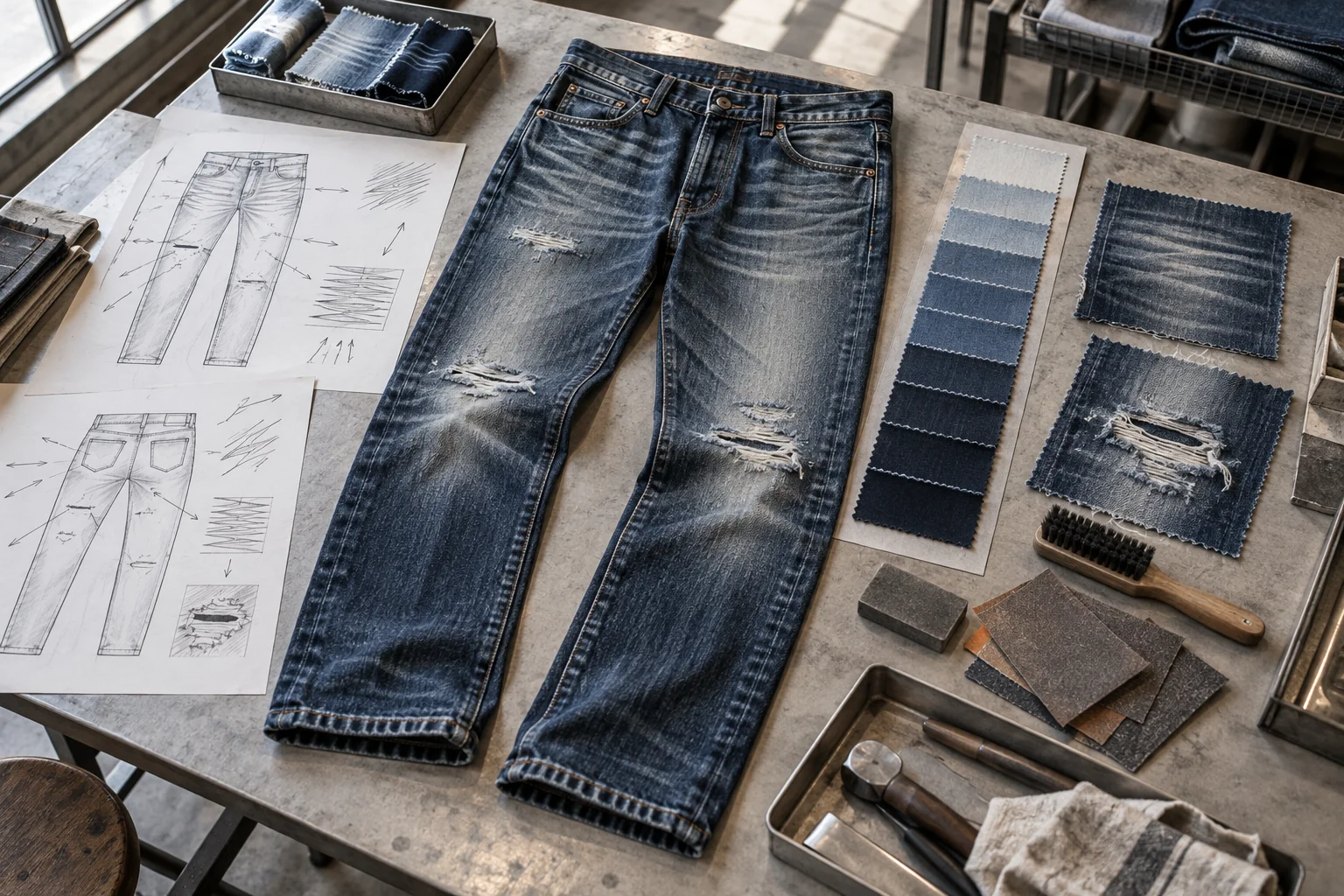
Briefing a distressed jeans manufacturer starts with a mapped damage specification, not a mood image alone. Define abrasion intensity, whisker geometry, rip openings, reinforcement, and areas that must remain intact. Connect those details to the selected denim, finishing sequence, acceptable shade band, residual strength, and measurements after washing. Plan around MOQ 100 pcs per color per design, with fabric and component minimums checked separately. Samples take approximately 7 days once the brief and materials are confirmed; bulk timing depends on quantity, material readiness, finishing capacity, and approvals. Release production against actual-material samples and documented limits for both appearance and performance.
At a glance
Swipe the table sideways to compare both columns →
| Brief element | Evidence to request | Release control |
|---|---|---|
| Abrasion and crease map | Dimensioned front and back views with intensity zones and protected areas | Approve placement, boundaries, and variation by size |
| Distressing method | Operation sequence, equipment route, and actual-fabric trials | Control substitutions between hand and machine processes |
| Holes and reinforcement | Opening dimensions, retained yarn details, backing, and attachment samples | Check tear growth, coverage, and seam clearance |
| Shade, strength, and fit | Finished shade limits, agreed performance results, and measurement reports | Evaluate the complete finished garment rather than appearance alone |
| Quantity and approval gates | Style-color-size matrix, sample records, and finishing capacity assumptions | Confirm minimums and written bulk release conditions |
1. Give your distressed jeans manufacturer a measurable map
Start with front, back, and detail views that distinguish intentional distress from ordinary garment defects. Assign each abrasion zone, whisker group, scrape, hole, and rip a reference code that appears on the specification and sample comments. Locate features from defined measurement points, such as the waistband seam, inseam intersection, or pocket edge, rather than relying on an image scale. State whether dimensions refer to the garment before processing or after the complete finishing route. Include clear views of areas that must remain intact, especially pocket bags, fly construction, belt loop attachments, and structural seams. A vintage wash brief may emphasize aged shade and softened surfaces without intentional openings; this brief must additionally control material removal and exposed structure. Use inspiration images to communicate character, but require a dimensioned map before treating any supplier interpretation as a production instruction for the order.
Describe intensity with approved physical references and observable boundaries instead of words such as heavy or authentic alone. For each zone, specify the intended surface effect, maximum footprint, transition into undamaged cloth, and whether underlying yarns may become exposed. Separate a pale abrasion patch from a weakened patch: the two can look similar while behaving differently during wear. Define deliberate asymmetry so inspectors do not reject an approved left-right difference or accept accidental imbalance. Explain how placement changes across the size range, especially when knee position, thigh width, and pocket spacing shift. Proportional scaling is not automatically appropriate for every opening. Review selected small and large sizes against the base size and record any fixed dimensions or relocated features. Keep the approved map revision attached to the pattern and finishing instructions so obsolete artwork does not reach the distressing station.
2. Specify process outcomes and qualify the proposed methods
Ask the supplier to propose an operation route for each mapped feature, identifying hand sanding, mechanical abrasion, laser treatment, cutting, or other processes where applicable. Do not treat handwork as automatically superior or machine processing as automatically consistent. Hand sanding depends on operator technique, pressure, garment support, and abrasive condition; mechanical or laser routes still depend on settings, fabric response, positioning, and subsequent washing. Request actual-fabric trials that compare the intended appearance with unwanted thinning, sharp edges, scorch marks where relevant, or damage outside the mapped boundary. Specify the approved result and critical process controls without assuming that a photograph reveals how the effect was made. Confirm who authorizes a change of method and when a new trial is required. Prohibit unapproved abrasive blasting and ask how the factory manages dust, ventilation, equipment guarding, and worker protection for its proposed operations.
Treat whiskers and chevrons as shaped features with their own instructions, not as a generic wash option. Mark the origin, direction, length, spacing, curvature, and fade boundaries of each crease group. For chevrons behind the knee, check alignment with the intended leg shape and the wearer's bending area rather than copying a fixed position from another silhouette. Specify whether lines should read as soft tonal changes, raised crease effects, or visibly abraded ridges. Require the supplier to disclose any forming or chemical treatment that changes handfeel, strength, or applicable compliance obligations. Review these effects after the complete wash and finishing sequence because intermediate contrast can differ from the final result. Record garment positioning aids, reference templates, and first-piece checks where used. Approve a bounded amount of variation, while keeping misplaced lines, abrupt transitions, and damage to neighboring seams outside that allowance.
3. Define holes, rips, and reinforcement as construction details
Give every opening a separate detail sheet showing its location, orientation, finished length, width, and relationship to nearby seams. Distinguish a closed slit, an open hole, a frayed edge, and an area with retained crosswise yarns; these are not interchangeable interpretations of ripped denim. Specify which yarn system should remain where relevant and use close photographs of the approved sample to support the written description. State how the opening is measured, including whether the garment lies relaxed and whether loose fringe is excluded. Mark minimum clearance from pockets, side seams, inseams, and other load-bearing construction according to the approved design. Assess the opening with the garment worn or articulated, since a small relaxed slit can expose substantially more area under tension. Review intended coverage and any sharp or uncomfortable edges before accepting the design, particularly where hardware or reinforcement touches skin.
Decide whether each distressed area should remain unsupported, receive an internal patch, or use another reinforcement construction. Specify backing composition, color, stretch direction, dimensions, edge finish, and attachment method where a backing is required. A backing that restricts stretch may alter comfort and transfer stress to its attachment points, while a highly flexible backing may not control the intended opening. Review the outside appearance and inside finish together, including visible stitch lines, patch show-through, and pocket interference. Establish whether reinforcement is applied before or after distressing and washing, and validate that exact sequence on the sample. Washing can change patch dimensions, adhesive behavior where used, and thread appearance. Agree an acceptable amount of fraying or tear extension after the defined evaluation, with a clear failure boundary. Do not assume reinforcement eliminates tear growth; request evidence on the finished construction before approving it.
4. Approve shade, residual strength, and fit after distressing
Approve the fabric article and the full finishing sequence as one combination. Record composition, weight and its measurement condition, stretch direction where applicable, fabric lot, and intended operations. The order of abrasion, opening creation, washing, tinting where specified, and reinforcement can change both appearance and performance. Require a target garment and labeled acceptable light and dark limits after the complete route, viewed under agreed lighting and garment condition. Assess the base shade separately from local abrasion contrast so a garment cannot pass merely because its overall color falls within the band. Check pocket edges, seams, repair patches, and exposed yarns for unintended contrast or staining. Keep abrasion placement limits separate from shade limits. A shade band cannot authorize a larger hole, misplaced whiskers, or panel mismatch. Material substitutions and meaningful route changes should trigger renewed review rather than inheriting the original approval.
Define residual strength as an agreed performance requirement, not a claim inferred from fabric weight or a convincing appearance. Ask a competent laboratory or testing team to recommend suitable tensile, tear, seam, or other evaluations for the fabric and construction, with methods, sampling locations, conditioning, and acceptance limits agreed before testing. An intentional opening may require garment-level evaluation because a conventional specimen cannot represent its geometry or reinforcement. Compare finished distressed areas with relevant undistressed controls when useful, but do not substitute a comparison for a minimum acceptance requirement. Include an agreed laundering or wear evaluation to assess opening growth, retained yarn loss, patch attachment, and edge comfort. Measure fit after the complete route and specified relaxation period, recording waist, rise, thigh, knee, inseam, and leg opening as appropriate. Investigate whether deviations arise from patterns, processing, or reinforcement before approving corrections.
5. Reconcile minimums and establish staged sample approvals
Use MOQ 100 pcs per color per design as the garment planning basis and submit a matrix of designs, colors, distress treatments, and sizes. Ask whether different damage maps or wash routes count as separate designs or colors for quotation purposes. Do not assume two jeans sharing a fabric and silhouette can share one minimum when their processing requirements differ. Check fabric, backing, thread, hardware, labels, and packaging minimums separately, including development consumption and ownership of unused materials. Request a capacity plan that identifies manual distressing stations, machine availability, laundry booking, reinforcement work, and inspection time. A sewing output figure alone does not establish finishing capacity for a detailed ripped-jeans program. Bulk timing depends on quantity, material readiness, process complexity, available capacity, and approval dates. Confirm these dependencies in the schedule and identify who must authorize split lots or split shipments.
Samples take approximately 7 days once the brief and materials are confirmed, but clarify what that first submission includes. Custom material procurement, multiple process trials, testing, shipping, and buyer revisions need separate allowances. Use mapped panels or legs to screen abrasion and opening ideas, a complete actual-material garment to review their interaction with fit, and selected sizes to confirm placement across the range. Do not let approval of a panel authorize bulk garment processing. Before release, require a preproduction sample using the intended fabric, reinforcement, trims, and complete finishing route. Link it to the map revision, pattern version, bill of materials, measurement report, shade references, and agreed performance results. Record accepted deviations explicitly and retain matching references with buyer and supplier. If one item remains provisional, state which operations may proceed and which remain blocked; silence after delivery is not approval.
6. Carry the approved damage limits into bulk inspection
Translate the approved sample into station-level instructions that operators and inspectors can use without interpreting a buyer mood board. Show feature codes, placement references, acceptable boundaries, protected areas, and examples of unacceptable damage. Maintain traceability from fabric rolls and cut bundles through distressing, washing, reinforcement, and packing so a problem can be isolated to its relevant production group. Require first-piece checks after setup and renewed checks when operators, tools, settings, fabric lots, or processing conditions change in ways that could affect the result. Inspect vulnerable areas before an irreversible operation hides or enlarges the damage. Establish who can stop processing and how suspect goods are held apart from accepted work. Outside laundries and specialist processing sites should receive the current controlled instructions, while the contracting supplier remains accountable for coordinating approvals and reporting changes to the buyer before affected work proceeds.
Build the final inspection plan around both ordinary workmanship and the intentional damage specification. Agree sampling that represents sizes, fabric lots, finishing batches, and relevant processing routes rather than inspecting only the easiest cartons to reach. Review shade, feature placement, opening dimensions, retained yarns, reinforcement security, seam clearance, measurements, and packaging against their separate acceptance criteria. Distinguish approved fraying from uncontrolled tear growth and approved asymmetry from a missed operation. Define which defects require repair, rejection, further evaluation, or buyer disposition, and identify findings that trigger a wider hold. Additional abrasion or rewashing should require authorization because it can consume remaining strength and alter fit. Retest or reassess affected performance where the corrective action changes the construction or finish. Preserve final reports and retained garments for repeat orders, and require replacement fabric lots to be evaluated before reusing the previous distressing approval.
Send these details together
- Issue dimensioned front, back, and detail maps with feature codes, intensity references, protected areas, and size-placement rules.
- Qualify the proposed hand or machine methods on actual denim and document operation sequence and substitution controls.
- Define finished openings, retained yarns, seam clearance, reinforcement construction, and acceptable tear growth.
- Approve final shade limits, residual-strength requirements, laundering evaluation, and measurements after finishing.
- Confirm MOQ 100 pcs per color per design, separate component minimums, sample purposes, and finishing capacity.
- Connect written bulk release to controlled references, traceability, inspection criteria, and authorization for repair or rewash.
This guide covers buyer-side briefing and approval of distressed and destroyed jeans made by a China OEM supplier, including mapped abrasion, intentional openings, reinforcement, finishing, performance evaluation, and bulk inspection. It does not replace a complete wash-development brief or destination-market compliance review. MOQ 100 pcs per color per design is the garment planning basis; confirm treatment classification and separate material and component minimums. Samples take approximately 7 days once the brief and materials are confirmed; bulk timing depends on quantity, material readiness, finishing capacity, and approvals. Performance methods and acceptance limits must suit the actual fabric, construction, and intended use. Reprint attribution: denimmanufacturerchina.com.
Prepare a quote briefThe RFQ form prepares a WhatsApp message for you to review. For files, email sales@denimmanufacturerchina.com.
Questions before sampling
How is a distressed jeans brief different from a vintage wash brief?
A vintage wash brief can focus on aged shade, surface character, and handfeel without requiring intentional openings. A distressed jeans brief must additionally define where material is removed or weakened, which yarns remain, how openings are reinforced, and what variation is acceptable. The two can overlap, but approval of an aged color does not approve rip geometry, tear growth, or reduced strength.
Should buyers require hand sanding instead of machine distressing?
Not by default. Choose a method through actual-fabric trials and the supplier's ability to control placement, contrast, thinning, and repeatability. Hand sanding introduces operator-dependent variation, while machine processes still require suitable settings and positioning. Specify critical outcomes and prohibited methods, then approve the proposed route. A switch between methods should receive review when it could change appearance, strength, or worker-safety controls.
How should a buyer set strength requirements for ripped jeans?
Agree requirements with a qualified testing team based on the actual fabric, opening geometry, reinforcement, and intended use. Define methods, sampling locations, garment condition, and acceptance limits before testing. Intentionally open areas may need garment-level evaluation alongside suitable fabric or seam tests. Include agreed laundering or wear assessment for tear growth and attachment durability; fabric weight alone does not establish adequate remaining strength.
Can several distress maps share one 100-piece minimum?
Do not assume they can. Plan on MOQ 100 pcs per color per design and ask the supplier to classify each map and finishing route in writing. Different openings, reinforcement operations, or treatments can create separate production requirements even on the same fit block. Submit a quantity matrix by design, color, treatment, and size, and confirm fabric and component minimums separately.
What are your MOQ, sample time and bulk lead time?
MOQ is 100 pcs. Samples take 7 days. Bulk production lead time depends on order quantity.