Jeans Tech Pack Checklist: Fit, Wash and Hardware
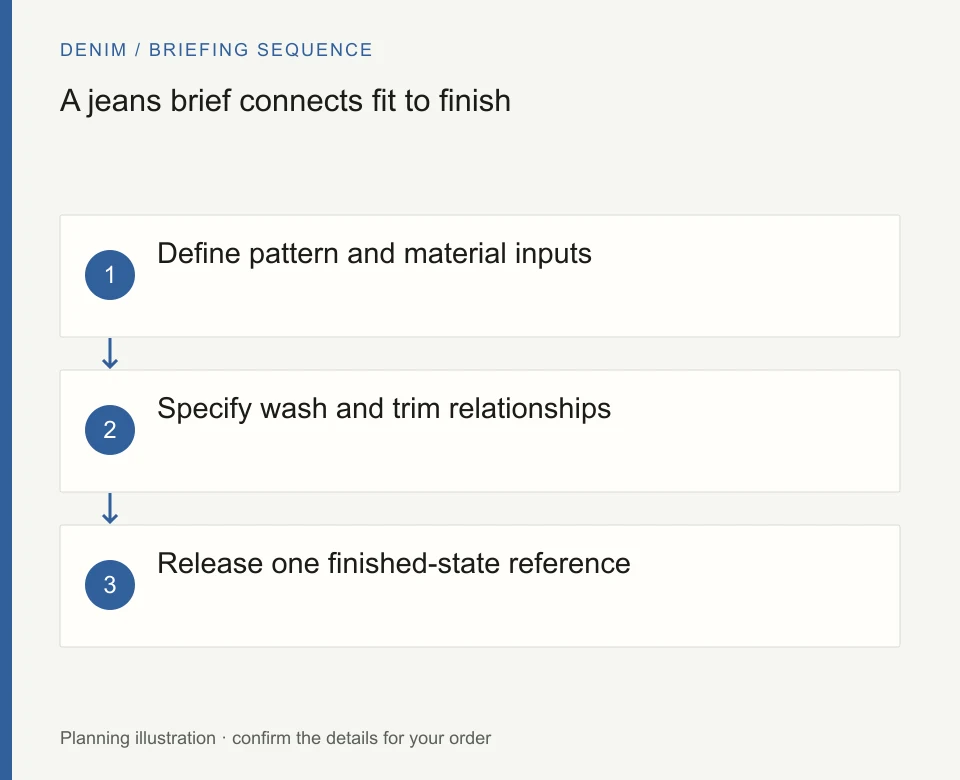
A jeans tech pack must connect the pattern to the fabric and final finish. A size chart measured before washing, a separate vintage reference and an unlabeled button image leave critical relationships unexplained. Give each detail a clear identifier and state the condition in which the finished jeans should be measured.
At a glance
Swipe the table sideways to compare both columns →
| Decision | What to specify | What to verify |
|---|---|---|
| Fit | Point diagrams and finished-state size chart | Keep pattern allowances separate from garment targets. |
| Material and wash | Fabric identity plus annotated appearance reference | State what the sample's finish actually represents. |
| Trim and release | Hardware map, files and revision record | Check the same version across every approval. |
Build the fit and construction record
Supply front and back flats plus detail drawings for the waistband, fly, yoke, pockets and hem. Identify the base size and measurement methods for waist, front and back rise, seat, thigh, knee, leg opening and inseam. Define the location of width measurements. A thigh figure is not reproducible if the two reviewers choose different distances below the crotch.
Show stitch lines and construction details where they affect appearance or function, and identify proposed thread colors. Keep finished targets separate from pattern allowances and acceptance tolerances. Ask the supplier to propose appropriate construction where it is unresolved. Copying a retail measurement chart cannot replace a pattern brief, especially when the intended material or wash differs from the reference garment.
Describe fabric and wash as separate inputs
State composition, weight, stretch or rigid direction, color and any specific fabric reference. Raw, washed and selvedge describe different aspects of the product and should not be used interchangeably. If the material is provisional, record that status. A sample made in another denim may help examine a pocket but may not demonstrate the final fit, shade or hand feel.
Annotate wash references with overall tone, contrast areas, abrasions and details to avoid. Ask for the proposed process to be confirmed rather than guessing it from a photograph. State that final measurements apply after the intended production finish when that is the approval basis. Keep any later care-check method distinct so production wash results are not confused with consumer-care behavior.
Finish the pack with trims and release control
List buttons, rivets, zipper, labels and patches with dimensions, finish and placement. Identify whether each component enters the wash or is attached afterward. Include artwork and a physical reference where necessary, but do not assume a branded trim shown online is available or authorized for use. Check the inside contact surfaces and interactions at the waistband and pocket corners on the sample.
Add quantity breakdown, size grading status and packing. Consolidate sample comments into a revised master and note changed fields. Ask the factory to acknowledge the version that governs the next sample or bulk stage. When the wash or fabric changes, revisit the measurement record rather than simply replacing one image in the pack and leaving an outdated size chart behind.
Define Which Instructions Apply to Each Jeans Variant
A tech pack covering several jeans colourways needs an applicability table, not just a shared style name. Give each saleable combination a code and show which instructions are common and which belong only to that combination. Useful columns include style code, colour code, size range, fabric article, pocketing reference, thread reference and artwork reference. Mark shared information explicitly rather than leaving cells empty, because an empty cell can mean either unchanged or undecided. For example, an indigo and an ecru version may share the same silhouette but require different pocketing opacity and thread colours. Write a rule such as: “Use the common construction sheet unless a colourway exception is listed here.” This lets our development team identify genuine variations without treating every page as a separate design or assuming that one approval covers every colour.
Separate commercial grouping from technical grouping before requesting a quotation. Two jeans offered under one collection name may require separate development if they use different materials, finishes or component sets. Conversely, several sales SKUs may refer to one construction with only size differences. Your pack should explain that relationship rather than making the factory infer it from product names. Our MOQ is 100 pcs per colour per design, so a quantity table should not imply that unrelated colourways can automatically be combined to meet that minimum. As an example to confirm, a proposed 200-piece order split across two colours could list 100 pieces against each colour, followed by the size allocation. Keep totals visible at both variant and order level. Flag any allocation that remains provisional so it does not become an accidental purchasing instruction.
Use an exception register when a shared detail changes for only part of the range. A larger size might need a different label position to avoid a seam, or one colourway might require a different care-label text because its composition differs. Give every exception a precise scope: affected variant, affected sizes, replacement instruction and approval owner. Avoid comments such as “adjust where necessary,” which transfer an undefined design decision to production. At sample review, check that the exception exists where intended and has not spread to unaffected variants. Before bulk release, ask for a variant-by-variant confirmation of exceptions rather than approving the collection as one undifferentiated group. This is especially useful when a buying team adds a late colour after the original sample has already established the default construction for the rest of the range.
Make the Bill of Materials Ready for Purchasing
A bill of materials should distinguish what belongs in one pair of jeans from how that material is purchased. Add columns for component code, description, unit of measure, usage basis, sourcing responsibility and approval status. Pocketing may be purchased by length while labels are ordered by piece; a zipper listing also needs to indicate whether lengths vary by size. Do not enter one unqualified number in a quantity column and expect purchasing to interpret it correctly. For example, “one waistband label per garment” describes garment usage, while spare labels and production loss belong in a separate purchasing calculation. Ask the factory to calculate consumption from the agreed pattern and usable material width. A preliminary costing estimate should stay marked as an estimate, not become a fixed issue quantity for cutting or a promise of actual consumption.
Identify nominated materials separately from performance-based requests. A nominated component means the buyer expects a specific supplier reference; a performance-based request allows the factory to propose an equivalent that meets stated requirements. These routes have different implications when a supplier runs out of stock. Write whether substitution is prohibited, permitted after review, or allowed within explicitly agreed limits. For a jeans pocketing substitution, approval might depend on composition, colour, opacity and its behaviour through the intended finish, rather than colour alone. Record who pays for any additional development and who has authority to accept the replacement. A purchasing note reading “similar quality acceptable” is too loose for private-label production because it does not define similarity. The practical aim is to prevent a material shortage from quietly becoming an unapproved product change before the buyer can assess the consequences.
Include a supplied-by-buyer register if your brand sends proprietary labels, packaging or other nominated components to China. List the expected arrival date, quantity, item codes and documents needed to identify each delivery. State whether the factory may begin the next operation before all supplied items arrive. A delayed waistband label may interrupt assembly, while a removable hangtag can sometimes be applied later, depending on the agreed workflow. Those dependencies should be visible before delivery dates are discussed. Also specify how shortages, damaged supplied goods and unused balances will be reported. Request reconciliation against received quantities rather than assuming that every delivered piece becomes a finished garment. At bulk handover, compare issued items, remaining stock and documented losses. This creates an auditable material record without confusing purchasing overage with your finished order quantity or authorising extra branded production.
Specify Digital Files That the Factory Can Actually Use
Treat the digital handoff as a technical deliverable with its own acceptance checks. A PDF may communicate the design clearly but still leave the pattern team without usable geometry or the artwork supplier without editable files. List each file, its purpose, its format and the software or export settings where relevant. If you supply patterns, identify the exchange format and ask the receiving team to confirm import compatibility before treating the pattern as production-ready. Do not assume that every file carrying the same extension transfers all annotations correctly. Include a read-only visual reference alongside editable files so the factory can check whether the imported result resembles the intended source. State which file governs which decision: pattern geometry, written construction instructions or artwork appearance. This avoids a flattened presentation image being mistaken for an authoritative cutting or engraving file.
For supplied jeans patterns, add a pattern inventory rather than sending an unexplained folder. Each piece should carry a name, size, cut quantity, grain direction and any required mirrored or paired relationship. Clearly state whether seam allowances are included and identify the units used. These are file interpretation requirements, not a substitute for agreeing finished garment measurements. A common failure is importing a file at the wrong scale or receiving pieces with notches stripped out. Include a calibration feature, for example a 100 mm reference square, and request confirmation of its imported dimensions before cutting. Ask the pattern team to report missing pieces, duplicated pieces and unclear notches together. If the factory is developing the pattern instead, specify which pattern outputs you expect to receive and when, rather than assuming that pattern files are automatically included in sample delivery.
Check print scale and font handling for placement templates, packaging artwork and any full-size design overlays. Put a visible scale check on pages that must print at actual size, and label presentation pages as not to scale. A placement instruction based on a PDF printed with “fit to page” can move a feature even when the numerical specification is correct. Supply fonts or outlined text where appropriate, while retaining an editable master in your own records. Specify whether colour values are communication references or approved production targets; a screen preview alone cannot establish a physical colour acceptance standard. Before ordering tooling or printed components, request a proof showing final dimensions, readable text and orientation. Check spelling, country-specific wording supplied by your compliance team and the direction in which artwork will appear on the finished jeans.
Control Open Questions Before They Become Production Assumptions
Give unresolved questions their own decision log instead of hiding them in drawing comments or messaging threads. Useful fields are query number, affected tech-pack field, factory proposal, buyer decision, responsible person and required decision date. Classify each question by the activity it blocks: quotation, material ordering, sample cutting, finishing or bulk release. This is more useful than marking everything urgent. For example, an undecided pocketing article may allow a preliminary quote but prevent a representative sample, while missing carton markings may not prevent sewing. Ask the factory to explain the consequence of proceeding without an answer. Your team can then choose deliberately between waiting and accepting a limited-purpose development step. Keep questions factual and answerable, such as whether a specified material may be replaced, rather than asking the factory to interpret a broad comment like “make it more premium.”
Write approval conditions as boundaries, not polite qualifications. “Approved except for comments” is risky when the comments include changes that affect subsequent operations. Instead, identify exactly what is accepted, what remains open and which activities may proceed. For example: “Pocket layout accepted for this sample only; do not purchase bulk pocketing until the replacement article is reviewed.” This separates a useful development decision from permission to commit production materials. Avoid using a general approval stamp on a sample made with temporary inputs. Mark those inputs and define which conclusions the sample can support. If a provisional sample uses substitute zipper lengths, it may show overall styling but cannot settle the final fly assembly across the size range. Ask the supplier to repeat the permitted next action in its acknowledgement so both teams understand the same release boundary.
Set a conflict-resolution rule for contradictory information before the pack reaches production. A drawing, a measurement table and a buyer comment can disagree even when each looks complete in isolation. The safest instruction is to stop the affected operation and raise a query, not to let the operator choose whichever instruction seems easiest. Name the buyer contact authorised to resolve technical conflicts and distinguish that role from commercial approval. Ask for the proposed correction and its consequences for materials, timing and already completed work. When an answer arrives through WhatsApp, transfer the decision into the relevant controlled field before authorising further work. WhatsApp is useful for clarification, but a message separated from its garment context can be misapplied. At handover, close each blocking query explicitly or carry it forward with a clearly limited permission to proceed.
Send these details together
- Front, back and construction detail drawings
- Base-size chart with exact measurement locations
- Fabric identity and separate wash-effect brief
- Hardware, patch and label placement package
- Quantity sheet and acknowledged final revision
- Variant applicability table with scoped exceptions and quantities.
- Purchase-ready BOM with substitution rules and sourcing responsibilities.
- Digital file inventory and closed blocking-query log.
Use this checklist to prepare your own order brief. Materials, processes, acceptance criteria and any applicable product requirements need order-specific confirmation; this guide is not a test report or availability guarantee.
Prepare a quote briefThe RFQ form prepares a WhatsApp message for you to review. For files, email sales@denimmanufacturerchina.com.
Questions before sampling
Can our brand send one tech pack for several jeans colourways?
Yes, if the pack clearly separates shared instructions from colour-specific requirements. Use an applicability table and make exceptions visible rather than duplicating nearly identical pages. Separate packs are often easier when materials or construction differ substantially. Keep the commercial breakdown clear either way: our MOQ is 100 pcs per colour per design. Ask us to confirm how your proposed variants are grouped before treating the combined quantity as an accepted order.
Does sample development start as soon as we email the tech pack?
Sending the file starts the review, not necessarily the sampling clock. Samples typically take about 7 days once the brief and materials are confirmed. Identify missing decisions and unavailable nominated inputs first, then agree whether to wait or make a limited-purpose sample. Bulk timing depends on quantity and is confirmed after sample approval. For clarification on your handoff and outstanding requirements, contact us on WhatsApp at +86 15920568771.
Should ownership of jeans patterns be stated in the tech pack?
Record the expected deliverables in the pack and agree ownership, access and reuse rights in your commercial terms. Distinguish buyer-supplied patterns from patterns developed by the factory. Specify whether you require editable files, which sizes must be included and when delivery is due. Also clarify whether development fees include those outputs. Receiving a physical sample does not, by itself, establish an agreement to transfer editable pattern files.
What are your MOQ, sample time and bulk lead time?
MOQ is 100 pcs. Samples take 7 days. Bulk production lead time depends on order quantity.