How to Evaluate Denim Manufacturers
Evaluate denim manufacturers by checking how they convert your garment brief into a repeatable production process, not by comparing factory photographs or broad supplier claims. For brand buyers sourcing China jeans OEM production, the relevant capability is garment cut-and-sew manufacturing supported by fabric sourcing, wash development, fit correction, shade management, and trim control. A denim mill produces fabric; it does not necessarily make finished garments. Start with a common technical brief, request comparable evidence, and use sample approvals to test the supplier's working method. MOQ is 100 pcs, samples take approximately 7 days once the brief and materials are confirmed, and bulk timing depends on quantity.
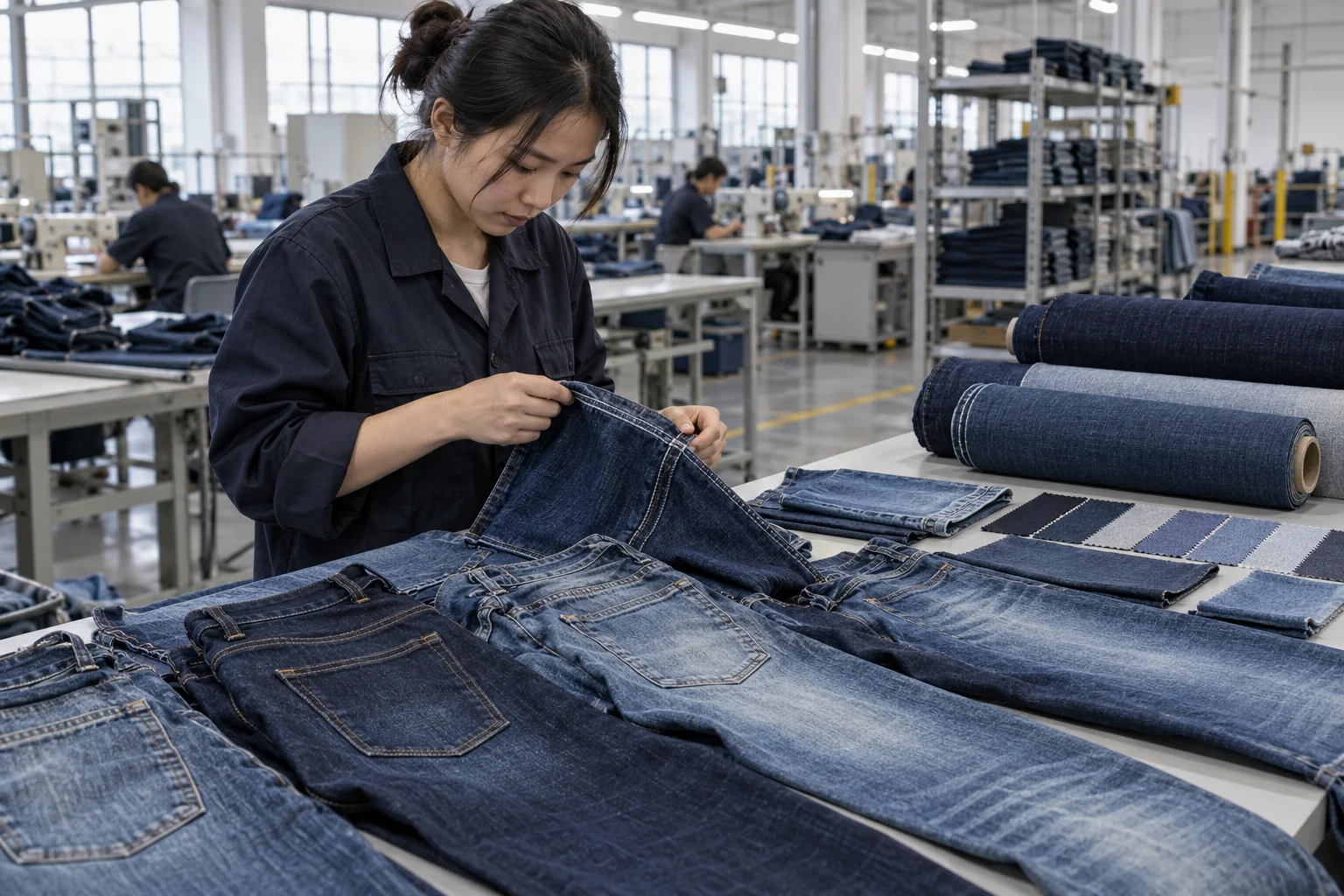
At a glance
Swipe the table sideways to compare both columns →
| Eval factor | Evidence to request | Red flag |
|---|---|---|
| Garment cut-and-sew capability | Relevant garment samples, operation breakdown, equipment explanation, and responsibility map for internal and subcontracted work | Fabric mill information presented as proof of finished-garment manufacturing capability |
| Wash range and appearance control | Comparable wash references, development method, approved appearance standard, and identification of the wash facility | Promises to match any image without reviewing fabric, construction, or wash feasibility |
| Fit sampling and measurement control | Sample measurement report, revision history, measurement method, and proposed tolerances for approval | Verbal fit approval or unexplained changes between sample versions |
| Shade and material traceability | Fabric lot identification, shade grouping procedure, cutting controls, and post-wash inspection plan | No method for separating fabric lots or investigating shade variation |
| Hardware, trims, and production planning | Trim specifications, attachment checks, itemized quotation, MOQ allocation, and quantity-based production schedule | Unapproved trim substitutions or a fixed bulk delivery promise before quantity and materials are confirmed |
1. Verify garment manufacturing capability before comparing prices
Begin by defining what you need the denim manufacturer to deliver: finished garments made to your specification, not simply access to denim fabric. Send a technical brief covering silhouette, fabric composition and weight, stretch expectations, construction details, wash direction, size range, and intended sales market. Ask the supplier to identify which operations it performs internally and which it coordinates through partners. Cutting, sewing, washing, finishing, and packing may involve different facilities, so evaluate responsibility and control rather than assuming every operation must share one address. Request relevant garment examples and an explanation of how comparable seams, pockets, waistbands, and belt loops are produced.
Use a structured review to distinguish actual capability from a polished sales presentation. Ask who owns the pattern, who checks fabric before cutting, how production instructions reach sewing lines, and who authorizes changes when a construction detail proves difficult. A video walkthrough or factory visit can support this review, but neither replaces a style-specific discussion with the technical team. Request documents with confidential buyer information removed rather than demanding another brand's proprietary files. The companion guide How to Choose a Denim Manufacturer addresses supplier selection more broadly; this evaluation method focuses on whether a manufacturer's working process can support your specific denim garment requirements.
2. Evaluate wash feasibility and shade control as connected tasks
Assess wash range against the actual fabric and garment construction, because a reference image alone cannot establish a reproducible finish. Ask the denim manufacturer to explain which wash and finishing effects it can develop, where the work is carried out, and what limitations apply to your selected material. Depending on the brief, discuss rinsed finishes, faded appearances, localized abrasion, tinting, or other requested effects without assuming all processes suit every fabric. Request development references that show relevant appearance rather than unrelated fashion samples. Agree on the physical reference, lighting conditions, review method, and acceptable visual variation before treating a wash sample as approved.
Shade control starts before washing and continues through garment inspection. Ask how incoming fabric rolls are identified, how shade differences are grouped, and how cutting instructions prevent unsuitable mixing of panels. Then ask how the factory handles wash batch identification, post-wash comparison, and segregation of garments that fall outside the agreed appearance range. The objective is controlled variation within a buyer-approved standard, not an unsupported promise that every garment will look identical. Record who evaluates disputed shades and which retained reference governs the decision. When reviewing competing quotations, use How to Compare Jeans Manufacturers China as companion reading for aligning wash scope and inspection assumptions before comparing prices.
3. Use fit samples and trim reviews to test execution
Treat sampling as a controlled development exercise rather than a request for a visually attractive prototype. Provide a measurement chart with measurement points, a size basis, construction notes, and proposed tolerances for discussion. Ask the manufacturer to identify uncertainties before making the sample, especially where wash shrinkage, stretch recovery, or fabric behavior may affect the finished fit. Samples take approximately 7 days once the brief and materials are confirmed; clarify whether that stage covers the requested wash and trims, and allow for additional revision rounds when needed. Review the garment after the intended finishing process, document measurement differences, and return consolidated comments so the next version has one clear instruction set.
Evaluate hardware and trims with the same discipline as fit. Specify zipper type, button and rivet appearance, label content, patch material, thread direction, and packaging requirements where applicable. Ask for a trim approval record identifying the selected items and any proposed alternatives. Check attachment appearance, operation, placement, and compatibility with the intended wash; any testing requirement should be agreed explicitly rather than inferred from a supplier's general claim. Do not treat an unverified certificate or an unrelated report as proof that your finished garment meets a market requirement. Keep a revision log and a retained approved sample so bulk production is not based on scattered messages or outdated trim photographs.
4. Compare commercial terms and approve a production control plan
Once technical feasibility is established, request an itemized quotation against the same brief from each shortlisted denim manufacturer. Separate fabric, garment construction, wash development, trims, packaging, sample charges, and any agreed inspection or testing costs where possible. MOQ is 100 pcs, but confirm how that minimum applies to the proposed style, fabric, wash, color, and size allocation before building an assortment around it. Do not assume that every combination can share the same minimum. Ask what changes would trigger a revised price or schedule, including material substitution and additional sample rounds. A lower quotation is not comparable if it omits the wash complexity or trim specification required by your brand.
Before issuing the bulk order, agree on the production checkpoints and release authority. Confirm the approved specification version, material availability, sample approval status, measurement standards, appearance references, and handling of nonconforming goods. Bulk timing depends on quantity, so request a schedule based on the actual order rather than accepting a universal lead-time promise. Identify milestones for material readiness, cutting, sewing, washing, inspection, and packing, with a named contact responsible for updates. The companion guide How to Work With a Denim Factory in China covers ongoing coordination after selection. Your final decision should reflect technical evidence, communication quality, and documented controls, not a ranked list or a supplier's preferred marketing label.
Send these details together
- Send one consistent technical brief to every supplier, including garment construction, fabric requirements, wash references, measurements, trims, and the intended market, so responses can be evaluated on equivalent scope.
- Confirm that the supplier manages finished denim garment production and identify the responsible facility or partner for cutting, sewing, washing, finishing, and packing.
- Approve fit, wash appearance, shade expectations, and trims through recorded references; retain the latest sample and prevent superseded specifications from reaching production.
- Confirm MOQ 100 pcs allocation in writing, clarify what the approximately 7-day sample stage includes after brief and material confirmation, and request bulk timing against actual quantity.
- Review the quotation, approval gates, inspection responsibilities, substitution rules, and corrective action process before placing the order; verify any compliance evidence against its stated product and scope.
This informational BuyingResource is a method guide for brand buyers evaluating China jeans OEM and denim garment cut-and-sew manufacturers, not a ranked supplier list or a denim mill sourcing guide. It does not claim laboratory results, guaranteed certifications, or universal regulatory compliance. You may reprint this guide with attribution to denimmanufacturerchina.com and sales@denimmanufacturerchina.com.
Prepare a quote briefThe RFQ form prepares a WhatsApp message for you to review. For files, email sales@denimmanufacturerchina.com.
Questions before sampling
How can a brand buyer distinguish a denim manufacturer from a denim mill?
Ask what the supplier actually produces and controls. A denim mill makes fabric, while a garment manufacturer coordinates the conversion of fabric into finished products through pattern development, cutting, sewing, washing, and finishing. Some businesses offer both capabilities or work through partners, so the label alone is not decisive. Request garment-specific samples, a production responsibility map, and an explanation of fit and wash approvals. Evaluate the disclosed process rather than assuming that fabric expertise automatically includes finished-garment manufacturing.
What should buyers confirm about MOQ and sampling before requesting a quote?
MOQ is 100 pcs. Confirm whether the proposed allocation across styles, washes, colors, and sizes fits that minimum, and ask whether any selected materials or trims introduce separate purchasing constraints. Samples take approximately 7 days once the brief and materials are confirmed. Establish what the sample includes and whether custom components or later revisions need additional scheduling. Bulk timing depends on quantity and should be confirmed against the actual order, material readiness, and approval status.
What evidence matters most when comparing denim manufacturers?
Prioritize evidence tied to your garment: relevant construction samples, a clear sampling workflow, measurement records, wash references, shade control procedures, trim approvals, and an itemized production plan. Generic factory claims or a wide product catalog cannot replace those checks. If testing or certification is required for your market or purchase specification, request applicable documentation and verify its issuer, validity, and scope. Do not assume that a document covering one material, facility, or product automatically covers your finished order.
What are your MOQ, sample time and bulk lead time?
MOQ is 100 pcs. Samples take 7 days. Bulk production lead time depends on order quantity.