Denim Wash Approval Checklist for Buyers
Use this denim wash approval checklist for buyers to turn a sample review into a documented bulk release decision. Connect the submitted garment to its fabric article, recipe revision, laundry, and processing sequence before evaluating shade, handfeel, abrasion, and finished measurements. Approve a shade band across representative sizes and require evidence for residual chemistry requirements rather than judging safety by touch or smell. Plan around MOQ 100 pcs per color per design. Samples take approximately 7 days once the brief and materials are confirmed; bulk timing depends on quantity, material readiness, laundry capacity, testing needs, and approval closure.
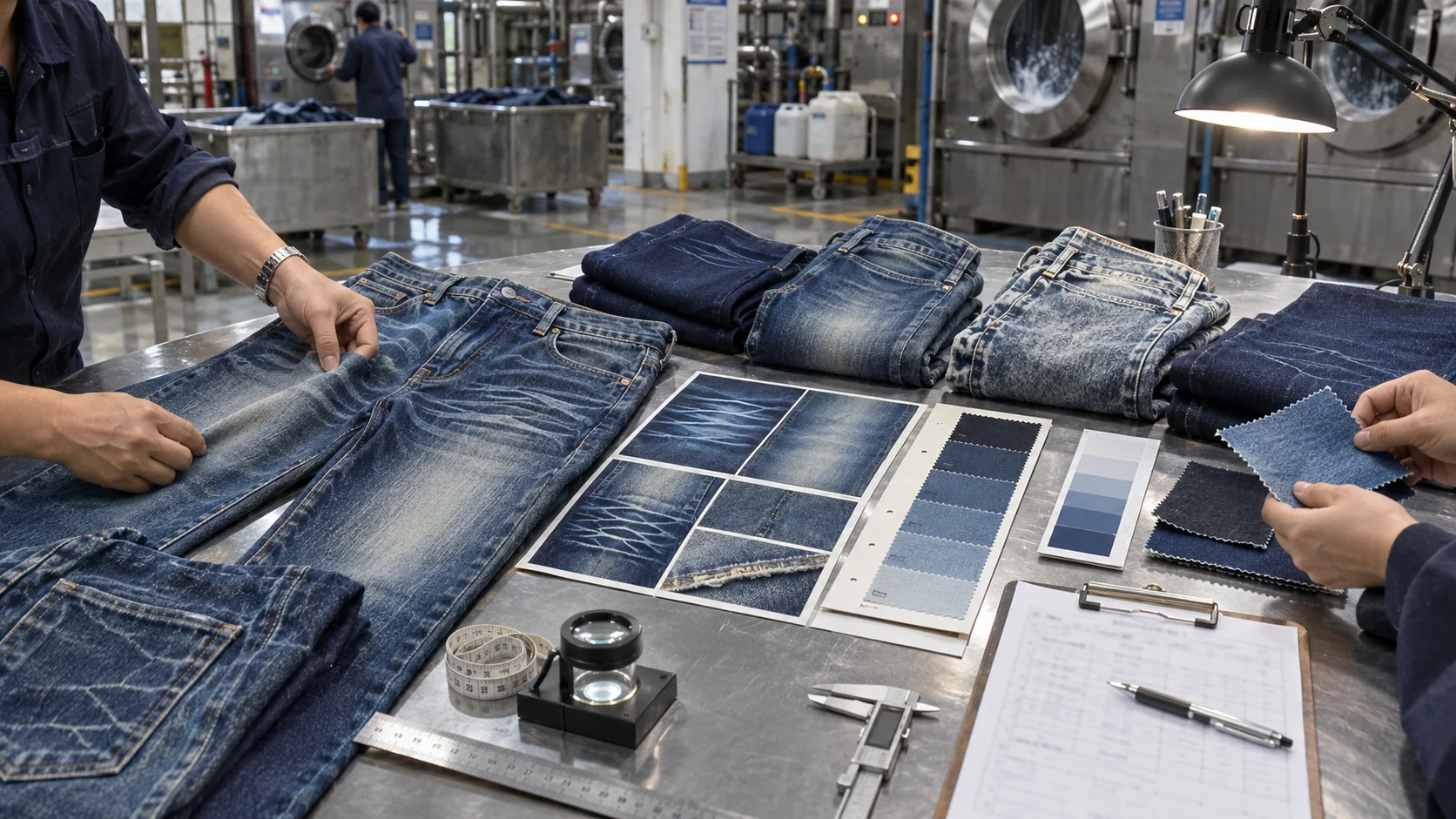
At a glance
Swipe the table sideways to compare both columns →
| Approval gate | Evidence to review | Release decision |
|---|---|---|
| Recipe and route identity | Fabric article and lot, recipe revision, laundry, process sequence, and sample record | Accept only a sample linked to the proposed bulk route |
| Shade across sizes | Target garment, labeled light and dark limits, representative sizes, and viewing conditions | Approve a bounded shade range without accepting panel mismatch |
| Abrasion and construction | Placement map, size-specific references, seam checks, and finished measurements | Separate intentional effects from damage and fit deviations |
| Handfeel and residual chemistry | Conditioned reference garments, finishing-agent records, and applicable test evidence | Keep sensory approval separate from chemical acceptance |
| Bulk authorization | Signed approval matrix, retained references, pilot results, and change-control rules | Release only the defined scope after required conditions close |
1. Apply the denim wash approval checklist for buyers
Begin by defining what the submission is intended to approve. A wash panel can establish a direction for color or surface effect, but it cannot demonstrate complete garment behavior, pocket contrast, hardware interaction, or finished fit. A complete garment made in substitute denim also cannot authorize the quoted bulk article. Ask the supplier to label the submission as a development trial, wash approval sample, size comparison, or preproduction reference. Record which decisions are open and which have already been accepted. This guide addresses the approval boundary after a candidate wash exists; use /how-to-plan-denim-wash-development for organizing the earlier trial process. Keep the review sheet focused on observable results and traceable production inputs. A broad note such as wash approved leaves the laundry and sewing team guessing whether the buyer accepted shade alone or also accepted abrasion, handfeel, dimensions, and trim behavior.
Prepare a decision matrix with separate lines for route identity, shade, abrasion, handfeel, measurements, construction condition, chemical evidence, and labeling implications. Give each line a status such as accepted, rejected, or pending evidence, with the reviewer, date, and reference identifier. Use conditional approval only when the permitted work is explicit. For example, accepting abrasion placement while shade remains open should not authorize unrestricted bulk washing. State whether cutting, sewing, trim attachment, or laundry processing may proceed, and who bears the risk of authorized early work. Resolve conflicting buyer comments before issuing the consolidated response; the supplier should not choose between merchandising, technical, and quality instructions. If multiple washes share one design, give each wash its own approval record. Their common pattern does not establish that they have the same shrinkage, chemical exposure, processing time, or acceptable appearance after finishing.
2. Identify the recipe and the route behind the sample
Require a stable wash reference and revision number linked to the exact submitted garment. The record should identify the fabric article, composition, fabric lot where available, garment construction version, sample size, laundry, and processing date. Ask the responsible laundry to retain the detailed process instructions, including the operation sequence, relevant chemical additions, treatment conditions, rinsing, extraction, drying, and final finishing. Where recipe details are confidential, agree controlled access and require enough information to verify identity, manage changes, and investigate failures. A marketing wash name is not a recipe identifier. Terms such as vintage blue or soft rinse describe an intention, not a reproducible instruction. Use /types-of-denim-washes to clarify process terminology, then document the actual combination used for this order. The buyer's approval should connect the visible result to a controlled revision without implying that an unchanged recipe always produces an identical result.
Check whether the sample route can be transferred to the proposed production equipment and load conditions. Request the machine category, sample versus bulk loading basis, drying method, manual treatment stages, and any planned production adjustment. Laboratory or small-load success does not establish that bulk garments will receive equivalent treatment. Ask how the laundry will validate the transfer through a representative pilot or first production batch before processing the balance. Record whether patches, buttons, rivets, labels, and other components were present during washing, because their sequence can affect staining, corrosion, distortion, or contrast. If bulk components will be different, leave their interaction unresolved rather than extending approval by assumption. Name the person authorized to approve recipe adjustments. Changes to the fabric, laundry, finishing agent, equipment route, or treatment intensity should trigger a documented assessment and renewed sampling when appearance, fit, strength, or chemical acceptance could change.
3. Approve shade limits across representative sizes
Review the target garment and proposed shade limits together under agreed lighting and viewing conditions. Use clean, dry garments that have been allowed to reach the agreed evaluation condition rather than comparing a warm, recently finished sample with an older reference. Identify acceptable light and dark limits, but also assess hue and cast; a garment can sit between two lightness limits while still looking too green, red, or dull. Label the references with the wash code, fabric article, date, and approval status. Photographs can document placement and discussion, but camera settings and screens make them unsuitable as the sole shade authority. If instrumental color readings are used, agree the method, locations, and interpretation separately. Keep front, back, waistband, pocket, and seam comparisons visible during review. A shade band should bound acceptable variation, not excuse unintended differences between panels within one garment.
Request garments from representative sizes, including sizes near the ends of the ordered range where practical, and explain why those selections cover the program. Larger panels, different seam proportions, and localized abrasion scaling can change the visual balance even when the nominal recipe is unchanged. Compare each size against the common target and band, then assess whether whiskers, thigh highlights, knee effects, and pocket contrast remain proportionate. Do not create a separate tolerance for every size simply to accommodate inconsistent results. Record any intentional size-specific placement adjustment in the treatment instructions. Also ask how the pilot or first production batch will represent fabric lots and loading conditions that a small sample set cannot cover. Require garments outside the accepted range to be segregated for review. Mixing visibly different shades through packing is not a substitute for deciding whether those shades meet the purchase specification.
4. Separate approved abrasion from garment damage
Translate the desired abrasion into a placement map with reference photographs, garment landmarks, and acceptable boundaries. Define where contrast should begin and end, whether effects should be symmetrical, and which areas must remain free of distressing. Describe intended holes, fraying, edge wear, whiskers, and seam highlights separately rather than approving a general distressed appearance. A convincing sample can conceal an impractical treatment requirement if the effect depends on uncontrolled manual judgment. Ask the laundry how operators receive the placement instructions and compare work against retained references. For different sizes, specify whether positions follow fixed distances from seams or scale with garment proportions. Check front and back together so that isolated effects do not create an unintended imbalance. Distinguish acceptable handcrafted variation from incorrect location, excessive contrast, repeated tool marks, or damage extending into an area that should carry structural load during wear.
Inspect the garment inside and out after the intended finishing route. Examine pocket corners, belt loops, fly construction, waistband joins, crotch seams, hems, and hardware attachment areas for broken stitches, exposed yarn damage, tearing, or distortion. Check whether intentional abrasion has weakened an adjacent seam or made a pocket opening unstable. Pair visual review with appropriate performance testing where the design, fabric, or treatment intensity warrants it; visual acceptance alone does not establish durability. Measure the finished garment at agreed points and distinguish wash shrinkage from pattern or sewing errors. Review leg twist, seam puckering, and uneven hems as separate findings rather than treating them as part of a vintage effect. If corrective reprocessing is proposed, require another assessment of dimensions, appearance, construction, and relevant performance. A second treatment may improve color while making fabric damage or measurement deviations worse, so it needs its own release decision.
5. Separate handfeel approval from chemical acceptance
Evaluate handfeel using matching garment areas and a consistent conditioning procedure. Compare softness, surface drag, body, flexibility, and any greasy, waxy, or powdery sensation against the retained target. State whether the intended result is a temporary retail presentation or a feel expected to remain after the agreed consumer-care assessment. Softener application and drying can make a new sample feel acceptable while concealing differences that appear after airing or laundering. Request the finishing-agent identity and application stage in the controlled production record, together with restrictions on substitutions. For a detailed sensory review method, use /how-to-approve-denim-handfeel-samples; this approval gate should capture its result rather than repeat an entire handfeel development exercise. Keep comments specific enough to act on. Too stiff at the waistband is more useful than not premium, particularly when different garment areas receive different levels of abrasion or finishing during the approved route.
Keep chemical acceptance independent from touch, odor, and visual cleanliness. A pleasant handfeel does not demonstrate compliant residues, and an unusual odor is a reason to investigate rather than a diagnosis of a particular substance. Establish the destination-market requirements and buyer restricted-substance requirements before selecting test work. Ask a qualified laboratory or compliance adviser to define the relevant finished-garment tests, sampling approach, and acceptance criteria, which may include pH or other parameters where applicable. Review the sample identity, material and process scope, date, and results of any report offered as evidence. Chemical supplier documents and safety data sheets support process review but do not by themselves prove that the finished garment meets the purchase requirements. Document neutralization, rinsing, and drying controls where relevant to the route. If evidence is missing or the process changes materially, hold the affected approval line open until the required review is complete.
6. Close the approval record before bulk washing
Assemble one release package that connects the approved garment, shade limits, abrasion map, handfeel reference, measurement report, chemical evidence, and recipe revision. Include the bill of materials, component attachment sequence, laundry identity, and any pilot findings that affect production instructions. Retain matching references with the buyer and responsible production teams, with an agreed method for resolving differences between retained sets. Define how first-batch checks and later batch comparisons will be recorded, which findings stop processing, and who can authorize sorting, repair, rewash, or rejection. Preserve fabric lot and wash batch traceability through packing so an investigation can isolate affected goods. Approval should state what was accepted, what remains restricted, and whether any deviations apply only to the sample or also to bulk. An email saying proceed is insufficient if the underlying files contain conflicting revisions or unresolved comments from earlier development submissions.
Reconcile the release plan with MOQ 100 pcs per color per design, keeping fabric, trim, and laundry batch requirements separate. Confirm whether distinct wash effects count as separate color commitments and whether the proposed size split supports meaningful approval coverage. Samples take approximately 7 days once the brief and materials are confirmed; that allowance does not include every revision, laboratory review, shipment, or bulk pilot. Bulk timing depends on quantity, material readiness, laundry capacity, and approval closure. Put those dependencies into the schedule rather than compressing the review to preserve an unsupported ship date. Use /how-to-request-quotes-from-denim-manufacturers to include sampling, test work, pilot processing, and reinspection responsibilities in the quotation brief. When ready to discuss production, use /denim-manufacturer with the approval package and quantity matrix. Ask the proposed supplier to identify missing evidence and release dependencies before confirming the manufacturing scope.
Send these details together
- Identify the submitted garment, fabric article, recipe revision, laundry, sample purpose, and permitted approval scope.
- Approve a target and labeled shade limits under agreed viewing conditions, with representative size and fabric lot coverage.
- Record abrasion placement, allowable variation, construction findings, and finished measurement acceptance separately.
- Approve a conditioned handfeel reference and obtain the required chemical evidence without treating sensory checks as compliance proof.
- Retain matching references and issue one controlled release package with pilot gates, batch traceability, and change-control responsibilities.
- Confirm MOQ 100 pcs per color per design, separate process minimums, sample assumptions, and quantity-dependent bulk scheduling.
This guide covers buyer-side approval of a candidate denim wash before bulk production, including recipe identity, shade limits across sizes, abrasion, handfeel, chemical evidence, and release documentation. It does not replace wash development planning, a detailed handfeel assessment, laboratory advice, or destination-market compliance review. MOQ 100 pcs per color per design is the garment planning basis; confirm separate material, component, and laundry requirements. Samples take approximately 7 days once the brief and materials are confirmed; bulk timing depends on quantity, materials, capacity, and approval closure. Reprint attribution: denimmanufacturerchina.com.
Prepare a quote briefThe RFQ form prepares a WhatsApp message for you to review. For files, email sales@denimmanufacturerchina.com.
Questions before sampling
Can a buyer approve a denim wash from photographs alone?
Photographs are useful for discussing abrasion placement, contrast distribution, and visible defects, but they should not be the sole authority for shade or handfeel. Lighting, camera processing, and screens can change perceived color. Review physical target and limit garments under agreed conditions, retain matching references, and identify the exact fabric and recipe revision. Keep any photo-based approval limited to the features it can reliably demonstrate.
Does one approved size authorize the wash for every ordered size?
Not automatically. One size may establish the target appearance, but representative sizes should confirm that placement, visual balance, and finished dimensions remain acceptable across the range. Review sizes near the range ends where practical and document intentional placement adjustments. Also verify the proposed bulk route through an agreed pilot or first-batch gate, because size coverage alone does not demonstrate consistency across fabric lots or production loads.
What should buyers request when a laundry will not disclose its complete recipe?
Request a stable recipe identifier, revision control, named laundry, fabric linkage, processing sequence, and documented change rules. Agree how detailed records will be retained and accessed for investigation, testing, or authorized technical review. Confidentiality can be managed contractually, but it should not remove traceability. If the supplier cannot connect the approved sample to a controlled production route, keep bulk wash authorization unresolved.
Should bulk washing proceed while chemical test results are pending?
Treat required chemical evidence as an open approval gate. Any early work needs written authorization defining the permitted operations, affected quantities, financial responsibility, and hold conditions. Do not interpret shade or handfeel approval as chemical acceptance. Where the evidence is a prerequisite for bulk washing, keep that operation blocked until review closes. Use a qualified adviser to determine whether the submitted test scope covers the actual production route.
What are your MOQ, sample time and bulk lead time?
MOQ is 100 pcs. Samples take 7 days. Bulk production lead time depends on order quantity.