How to Brief a Vintage Wash Jeans Manufacturer
Brief a vintage wash jeans manufacturer with an identified denim article, a defined aging effect, and separate approvals for shade, abrasion, strength, and finished fit. Describe enzyme, stone, and tint combinations as development routes rather than assuming a recipe guarantees appearance. Use whisker and hand-sand maps, retained shade limits, and batch records to connect the approved sample to bulk. Plan around MOQ 100 pcs per color per design, checking material and laundry constraints separately. Samples take approximately 7 days once the brief and materials are confirmed; bulk timing depends on quantity, material readiness, laundry capacity, and approval progress.
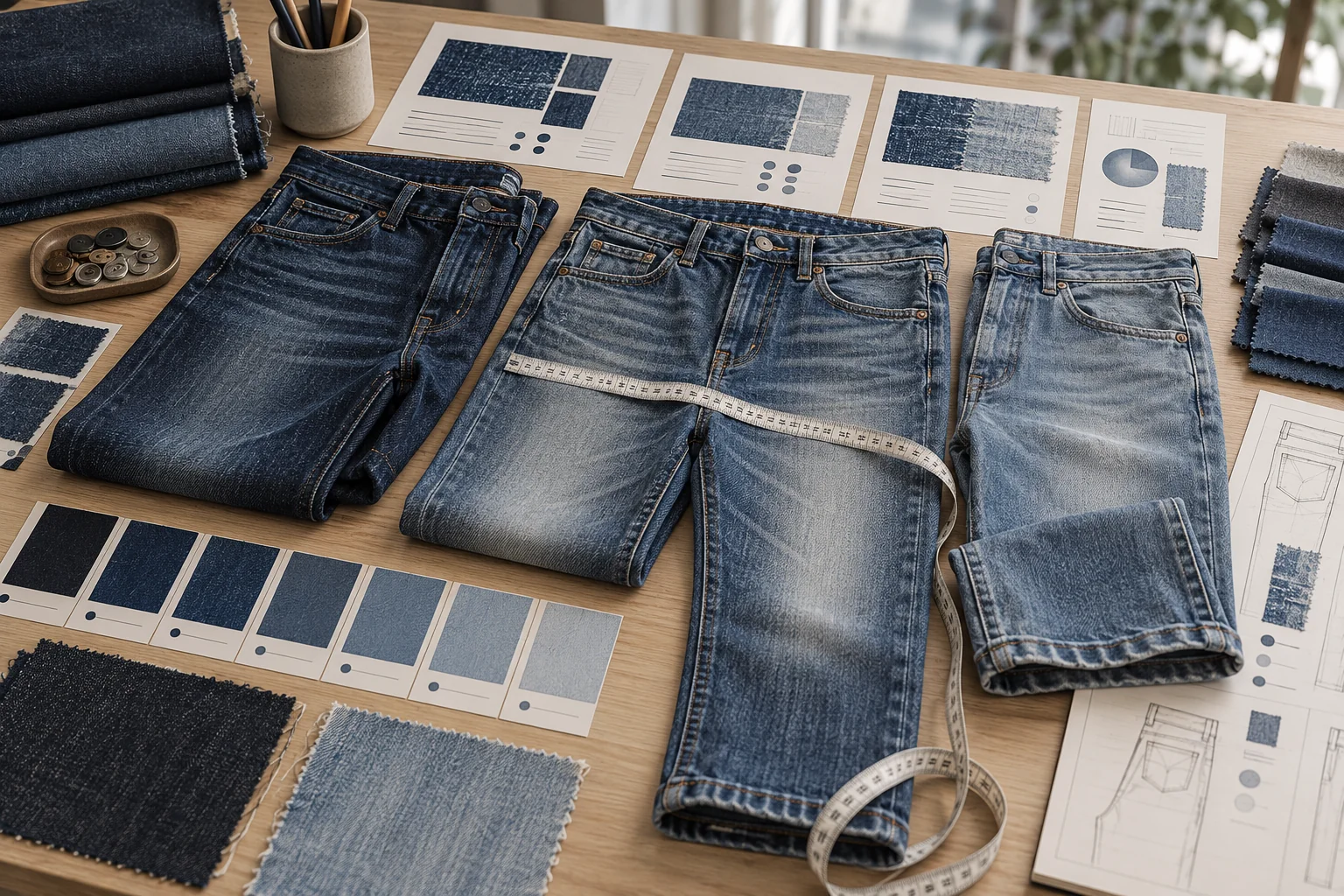
At a glance
Swipe the table sideways to compare both columns →
| Brief element | Evidence to request | Approval boundary |
|---|---|---|
| Vintage effect and route | Actual-fabric trials identifying enzyme, stone, tint, and finishing sequence | Approve appearance and handfeel separately from the proposed process |
| Whiskers and hand sanding | Placement maps, intensity references, and finished front and back views | Control location, transitions, symmetry, and permitted variation |
| Shade and batch continuity | Target garment, shade band, roll allocation, and laundry batch records | Hold outlying batches and review changes before mixing goods |
| Strength and finished fit | Post-wash performance results, measurements, and grading review | Release only the agreed construction and finishing combination |
| Quantities and sample gates | Style-color-size matrix, minimums, approval log, and bulk schedule | Separate development acceptance from authorization to cut and wash |
1. Give your vintage wash jeans manufacturer a measurable target
Start the brief with the appearance you want to buy, not simply the instruction vintage blue. Describe the base shade, overall fading, seam contrast, surface texture, handfeel, and intended tint cast. Include front, back, and detail references, but identify which features matter in each image. A photograph can communicate direction without establishing an exact shade because lighting, editing, and screen settings change its appearance. Request a physical target where shade is important, and explain whether it represents the desired result or only an inspiration. Separate global aging from localized wear so the supplier does not intensify every effect together. Record exclusions such as holes, open tears, exposed pocket bags, or intentionally broken yarns. Vintage washing can create an aged appearance without destroyed construction; any deliberate damage needs its own approval rather than being inferred from the style name.
Classify the program as a rinse-led aged look, a moderate vintage finish, or a heavier vintage treatment before requesting comparable quotations. These are brief categories, not universal industry grades, so define the expected result for each. A rinse-led option may retain a darker base with restrained contrast, while a heavier route may require more abrasion and color removal. Do not assume the heavier option is merely the same garment washed longer. It may require different fabric selection, reinforcement, processing allowances, or trim sequencing. Identify which effects are mandatory and which may be reduced if trials reveal unacceptable strength loss or dimensional change. Ask the supplier to quote the approved route rather than an undefined average wash cost. Keep alternative routes visible during development so a more aggressive treatment is not adopted solely to compensate for an unsuitable starting fabric.
2. Translate enzyme, stone, and tint language into controlled trials
Identify the proposed denim article before discussing the wash combination. Record composition, weight with its measurement condition, usable width, construction, stretch characteristics where applicable, and incoming shade or lot identity. Enzyme processing can modify the cotton surface and support a worn appearance; stone action introduces mechanical abrasion; tinting changes the color cast of the remaining fabric and exposed lighter areas. Their effects depend on the cloth and operating conditions, and the sequence can change the result. Ask the laundry to describe the purpose of each stage, including cleaning or rinsing between stages and any final softening. The buyer does not need to prescribe chemical doses without process expertise. Instead, require an identified trial route and a controlled production record that allows the supplier to investigate differences without replacing the agreed visual target with a recipe name.
Run trials that isolate meaningful choices rather than presenting several untraceable samples labeled vintage one and vintage two. For example, compare an enzyme-led route with an enzyme-and-stone route on the same article before deciding whether a tint is needed. Record each sample's fabric lot, process sequence, abrasion status, tint reference, and finishing condition. Review whether the tint changes pocketing, thread, labels, or patches, not only the denim face. Ask how the laundry controls unwanted redeposition of removed color onto lighter areas and how it checks that the final garment is adequately rinsed. A soft handfeel should not conceal weak fabric or unresolved finishing concerns. After selecting a route, retain its revision identity and define which changes require another trial. Substituting a fabric article, tint chemistry, or finishing sequence should not pass as a routine adjustment when appearance or performance could change.
3. Map whiskers and hand sanding without specifying destruction
Issue separate front and back abrasion maps using garment landmarks that production operators can locate consistently. Show whisker starting points, direction, spread, length, and intensity around the upper thigh and fly area. Define hand-sanded zones on the thighs, seat, pocket edges, and other approved locations, including how the lighter area should fade into the surrounding base. Avoid relying on a single shaded sketch that leaves operators to guess whether a boundary is sharp or feathered. Add close-up references for transitions and mark areas that must remain protected, such as critical seams or particular trim locations. For different sizes, state whether placement follows anatomical landmarks, scales with the garment, or stays at fixed distances from seams. Ask for representative size checks because a convincing map on the base size can look misplaced when copied unchanged across the size range.
Review the mapped abrasion on finished garments, since subsequent washing can soften a whisker, enlarge a pale zone, or make uneven sanding more visible. Define acceptable variation through labeled examples rather than demanding identical handwork without acknowledging the process. Distinguish intentional left-to-right differences from accidental imbalance, and specify whether pocket edges and seams should look gently aged or strongly highlighted. Require the supplier to identify the actual application method and any subcontracted operation; do not accept an undisclosed substitute simply because the sample photographs look similar. Where hand sanding is proposed, ask how abrasive work is controlled and workers are protected, and prohibit unapproved sandblasting substitution. Keep holes, cuts, and deliberately broken yarns outside this brief unless separately specified. If an abrasion trial accidentally creates damage, treat it as a failed boundary condition rather than relabeling the result as authentic vintage character.
4. Set shade limits and preserve continuity between batches
Approve a target garment together with labeled acceptable shade limits made on the intended fabric and finishing route. State the viewing conditions, garment condition, comparison method, and person authorized to resolve borderline results. For a tinted vintage finish, light and dark limits alone may not capture an unacceptable change in color cast. Include relevant tint boundaries or examples of rejected casts where needed. Also assess the relationship between the dark base, pale abrasion areas, seams, and pocket edges. Two garments can have similar overall depth while showing very different contrast. Keep shade approval distinct from approval of whisker placement, handfeel, and panel consistency. A garment within the shade band can still fail those requirements. Retain matching references with the buyer, factory, and laundry, and protect them from uncontrolled washing, prolonged light exposure, or confusion with later sample revisions.
Require traceability from fabric rolls and cutting bundles to laundry batches and finished inspection groups. Ask how the factory separates lots with different starting shades and whether those lots need individual wash trials before allocation. The laundry record should identify the approved route revision, machine or equipment reference, batch identity, loading information, and any adjustments or reprocessing. A development sample does not prove that a differently loaded production machine will reproduce its result. Agree an early production comparison at the intended operating conditions, followed by checks across subsequent batches. Do not let packing mix unreviewed shade groups simply to complete size ratios. For repeat orders, compare new fabric and finished trials with retained references before confirming continuity. Establish who can authorize rewash or retint, and require renewed appearance, strength, and measurement review when additional processing could alter the approved garment.
5. Verify residual strength and fit after the complete wash
Define the required post-wash performance before selecting the most aggressive visual sample. Residual strength means the useful strength remaining after the complete treatment, not merely the strength of incoming denim. Ask the supplier and testing provider to propose suitable fabric and garment evaluations for the intended use, then agree methods, specimen locations, conditioning, acceptance limits, and reporting requirements. Compare untreated or incoming material with finished material where that comparison helps explain process damage, but do not treat a percentage reduction alone as proof of fitness for use. Pay particular attention to sanded thighs, whisker intersections, pocket corners, seams, belt loops, and hardware attachment areas. Stretch articles also need attention to recovery and growth after processing. Ensure test samples represent the intended production route; a mild wash trial cannot establish the performance of a heavier finish that is later selected for bulk.
Measure fit after all approved washing, tinting, drying, and finishing steps, using an agreed relaxation or conditioning procedure. Record waist, rises, hip, thigh, knee, inseam, and leg opening through defined measurement points rather than informal comparisons against an unwashed sample. Ask the pattern team to separate fabric shrinkage allowances from silhouette corrections and to track both through revisions. A heavy vintage route may affect seam behavior, leg twisting, puckering, and stretch response differently from a rinse-led option, so shared patterns still need route-specific verification. Review the base size and an agreed selection of other sizes before releasing grading. If the selling proposition includes fit retention after consumer care, add an appropriate care-cycle evaluation under the intended instructions. Keep bulk measurement tolerances distinct from expected care shrinkage. An attractive sample that misses finished measurements should remain unresolved until the pattern or process is corrected and checked.
6. Reconcile minimums and release bulk through explicit gates
Plan on MOQ 100 pcs per color per design and submit a matrix listing designs, colors, wash routes, sizes, and requested quantities. Ask whether a different tint or vintage intensity counts as a separate color commitment; do not assume all blue washes can share one minimum. Check fabric purchase minimums, trim commitments, development consumption, and laundry operating constraints separately from the garment MOQ. A small order may be feasible in sewing while still requiring a different sourcing or batch plan. Ask how sample processing will relate to the proposed bulk load and what validation is needed before the first production wash. Samples take approximately 7 days once the brief and materials are confirmed, but custom fabric, unavailable trims, multiple trials, testing, shipping, and revisions need separate allowances. Request a dependency-based calendar rather than treating the first sample estimate as the duration of the complete development program.
Use approval gates that state what each submission proves and what remains blocked. Initial fabric and wash trials can narrow the route; a mapped complete garment can establish visual placement; fit and performance checks can qualify the selected combination. Before bulk release, approve an actual-material preproduction garment with the intended trims and processing sequence, supported by measurement results, performance evidence, shade limits, and the current bill of materials. Specify whether a first bulk wash batch must be held for review before the remaining garments proceed. Bulk timing depends on quantity, material readiness, sewing and laundry availability, and approval progress. Record who may approve deviations and which changes require renewed sampling. Inspection should cover different sizes and laundry batches, not only the easiest cartons to access. Agree hold, correction, reinspection, and cost-allocation procedures in purchasing documents, and do not treat silence after sample delivery as authorization to cut or wash.
Send these details together
- Define the vintage target, rinse versus heavy treatment, reference priorities, and exclusions for intentional damage.
- Identify the denim article and trial routes, including enzyme, stone, tint, rinsing, and finishing sequence.
- Approve whisker and hand-sand maps with placement, intensity, transitions, size adaptation, and protected areas.
- Retain a target garment and shade limits, including tint cast, with fabric-to-laundry batch traceability.
- Agree post-wash strength, stretch performance where relevant, finished measurements, and care-related evaluations.
- Confirm MOQ 100 pcs per color per design, separate minimums, sample gates, first-batch controls, and written bulk release.
This guide covers buyer-side briefing of vintage wash jeans OEM production in China, including wash-route development, mapped abrasion, shade continuity, residual strength, finished fit, and release controls. It does not provide chemical operating instructions or replace a separate specification for intentionally distressed or destroyed construction. Use MOQ 100 pcs per color per design as the garment planning basis and confirm material, trim, and laundry constraints separately. Samples take approximately 7 days once the brief and materials are confirmed; bulk timing depends on quantity, material readiness, capacity, and approvals. Performance methods, acceptance limits, destination-market requirements, and commercial responsibilities need agreement for the actual order. Reprint attribution: denimmanufacturerchina.com.
Prepare a quote briefThe RFQ form prepares a WhatsApp message for you to review. For files, email sales@denimmanufacturerchina.com.
Questions before sampling
Is vintage wash the same as distressed or destroyed denim?
No. Vintage wash generally describes an aged appearance created through color change, surface wear, contrast, and handfeel. It does not automatically authorize holes, cuts, or intentionally broken yarns. State those exclusions in the brief and approve whiskers and sanding separately. If deliberate damage is required, add its construction boundaries and performance checks rather than allowing the laundry to infer them from reference photographs.
Should the buyer specify an exact enzyme, stone, and tint recipe?
The buyer should define the target appearance, prohibited processes, performance requirements, and approval boundaries. Ask the manufacturer and laundry to develop and record the operating route for the actual fabric. A recipe copied from another article may produce different shade, abrasion, shrinkage, or strength. Approve traceable trials and require change control instead of assuming a recipe name establishes an equivalent finished garment.
Can rinse and heavy vintage versions use the same fit approval?
Do not assume they can. Different processing routes can change shrinkage, seam behavior, handfeel, and stretch recovery even when the starting pattern and fabric are shared. Measure finished samples from each proposed route and review representative sizes. A common fit specification may remain appropriate, but the factory may need separate processing allowances or pattern revisions to meet it consistently.
What should happen if a bulk vintage wash batch misses the shade band?
Hold the affected batch and preserve its fabric, cutting, and laundry records. Compare it with the retained target and limits under the agreed viewing conditions, then investigate the cause before proposing correction. Rewash or retint needs authorization because it can affect strength, fit, and trims. Review corrected goods again and do not mix unresolved batches into packing to complete the order.
What are your MOQ, sample time and bulk lead time?
MOQ is 100 pcs. Samples take 7 days. Bulk production lead time depends on order quantity.