Jeans Pocket Placement: Scale, Position and Function
Jeans pockets shape the appearance of the front and back as well as providing storage. Their dimensions, opening, angle and distance from seams need separate decisions. A pocket traced from a reference garment can look wrong on a different rise or seat, even when its own outline has been copied accurately.
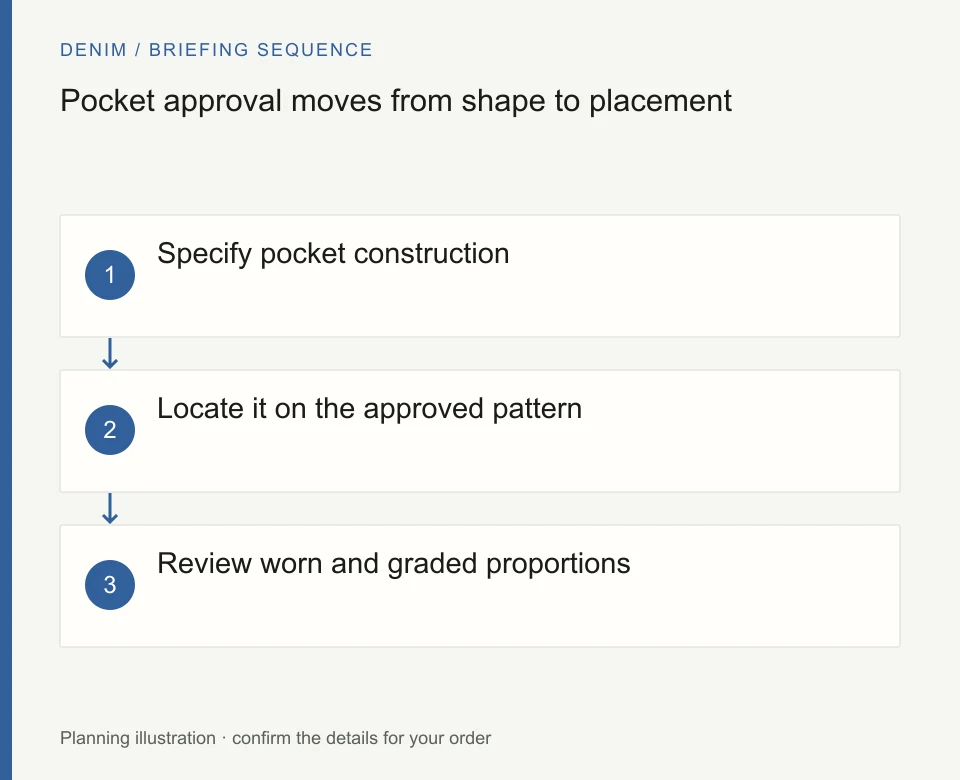
At a glance
Swipe the table sideways to compare both columns →
| Decision | What to specify | What to verify |
|---|---|---|
| Front pocket | Opening, bag depth and internal construction | Check access on the worn sample. |
| Back pocket | Shape, angle and defined placement distances | Review against the approved seat and yoke. |
| Range and finish | Grading rule plus final wash appearance | Reopen placement after dependent pattern changes. |
Define front-pocket access and construction
Draw the opening curve, pocket bag and any coin pocket. State usable opening and bag depth separately from the visible shape. If a particular object informs the design, give its dimensions as a reference rather than promising universal capacity. Check access while standing and sitting, since a pocket can appear generous laid flat but feel restricted when the jeans are worn.
Identify pocket bag material, edge construction and reinforcement points for discussion. Consider the interaction with the fly, waistband and nearby hardware. A rivet or thick seam allowance can affect contact and access even if the pocket outline is correct. Request a representative sewn sample and inspect the inside, not only the exterior front photograph used in a design presentation.
Position back pockets against the seat and yoke
Specify pocket width, height, shape and any topstitch design. Locate it from defined references such as the center-back seam, yoke seam and pocket top, with the intended angle shown. Avoid mixing distances measured along a seam with straight horizontal distances. A diagram should make the method clear enough that a second reviewer can reproduce the placement on the sample.
Review the pair in relation to seat width and rise. Moving pockets outward, downward or changing their size alters the visual balance, but there is no universal flattering placement for every body and silhouette. Use the intended worn reference and your design goal. Check symmetry while recognizing that the garment must first be laid or worn consistently to make a meaningful comparison.
Carry the decision through finish and grading
Inspect pocket shape, seam effects and any decoration after the intended wash. Distressing or local contrast can change how the pocket boundary reads, so the finish reference belongs in the same approval. Check that functional access remains acceptable. Do not approve a pocket in an unfinished rigid sample as complete evidence for a softer or differently shaped washed garment.
Decide whether pocket size is fixed or graded and how placement changes across the range. Review selected extreme sizes where proportions can become most obvious. If the seat or yoke is revised, recheck the placement rather than carrying forward old offsets automatically. Archive the pocket pattern, placement diagram and final sample together so a reorder can repeat the decision with a consistent measurement basis.
Send these details together
- Front opening and pocket-bag construction drawing
- Back-pocket dimensions and stitch artwork
- Reproducible placement references and angles
- Finished sample with access and symmetry observations
- Pocket scaling and placement rule across sizes
Use this checklist to prepare your own order brief. Materials, processes, acceptance criteria and any applicable product requirements need order-specific confirmation; this guide is not a test report or availability guarantee.
Prepare a quote briefThe RFQ form prepares a WhatsApp message for you to review. For files, email sales@denimmanufacturerchina.com.
Questions before sampling
What are your MOQ, sample time and bulk lead time?
MOQ is 100 pcs. Samples take 7 days. Bulk production lead time depends on order quantity.